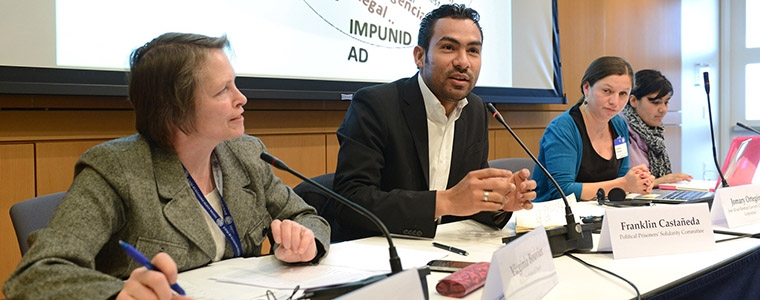
By: Virginia M. Bouvier, Lisa Haugaard and Moira Birss
Peace is more than just silencing guns. That was the upshot when Colombian human rights defenders gathered at USIP recently to discuss the ongoing peace process between the FARC guerrillas and Colombia’s government and how the talks can advance justice in the aftermath of a deal. Days later, in a development unrelated to the gathering, the Colombian government took a step in that direction.
Read more here at the USIP website.

Showing posts with label human rights. Show all posts
Wednesday, April 2, 2014
Monday, May 6, 2013
"No Justice? No Peace!" The Women Absent from Colombia's Peace Talks
This article originally appeared on The Women's International Perspective on May 3, 2013.
“No Justice? No Peace!” Never has this chant, which I have heard so often at anti-war rallies, felt so real to me as during the last few months observing the ongoing peace negotiations between the Colombian government and the FARC guerrillas. The talks began in October of last year in Oslo, Norway and have continued in Havana ever since. “No Justice? No Peace!” Never has this belief been more real to women peace activists in Colombia, who, despite the fact that not a single woman is at the negotiating table in Havana, are insisting on justice for achieving real and lasting peace in Colombia. Women peace activists in Colombia are putting their demands for peace into action through grassroots justice initiatives.
| • Yolanda Becerra presenting in the November 2012 Women's Court in the city of Barracabermeja. Photo credit: Lina Mucha.• |
Colombia’s nearly five decades of internal armed conflict has wreaked havoc on the country, resulting in countless deaths and leading to the internal displacement of between 4.9 and 5.5 million Colombians – over 10 percent of the country’s population. But even the little-known fact that Colombia’s internally displaced population rivals that of Sudan has received more attention than the ways this conflict has affected women. According to a comprehensive survey carried out in 2010 by national and international organizations, six women an hour were victims of sexual violence between 2001 and 2009.
Tuesday, December 13, 2011
Colombia's mining boom overshadowed by human rights violations
It's been quite a while since I posted here.... Let's just say that PBI has kept me quite busy. One of the things keeping me so busy was a report on the human rights implications of Colombia's mining boom (PDF), published last week. Below is some good media coverage of the report, with several quotes from yours truly, on the English-language news site Colombia Reports. I have an idea or two for original new blog posts, so stay tuned! -Moira
"80% of the human rights violations that have occurred in Colombia in the last ten years were committed in mining and energy-producing regions, and 87% of Colombia’s displaced population originate from these places," a report by the organization published last week said.
According to PBI spokesperson Moira Birss, mining activities are frequently accompanied by a disregard of the constitutional rights of minorities and threats and attacks on leaders of these communities.
"Community leaders who oppose mining projects, or the organizations that accompany those leaders and communities, have at times been targeted with threats and even attacks in what would appear to be a result of their opposition, as was the case with the priest who was killed in Marmato," said Birss, referring to an area where mining company Gran Colombia Gold and the local community are at odds over who has the rights to mine for gold.
Colombia's mining boom overshadowed by human rights violations: NGO
The apparent success of Colombia's mining boom is being overshadowed by human rights violations and mass displacement from mining areas, international human right organization Peace Brigades International (PBI) said Monday."80% of the human rights violations that have occurred in Colombia in the last ten years were committed in mining and energy-producing regions, and 87% of Colombia’s displaced population originate from these places," a report by the organization published last week said.
According to PBI spokesperson Moira Birss, mining activities are frequently accompanied by a disregard of the constitutional rights of minorities and threats and attacks on leaders of these communities.
"Community leaders who oppose mining projects, or the organizations that accompany those leaders and communities, have at times been targeted with threats and even attacks in what would appear to be a result of their opposition, as was the case with the priest who was killed in Marmato," said Birss, referring to an area where mining company Gran Colombia Gold and the local community are at odds over who has the rights to mine for gold.
Wednesday, August 17, 2011
Protecting their mother: Afro-Colombians fight to reclaim their land from palm oil
Upodate: a version of this blog was published on August 30 on the Women's International Perspective.
The first thing I notice after disembarking from the canoe that carried me across the Curbaradó River and scrambling up the bank are palm oil trees. Their rows of short, stout trunks topped by long green fronds stretch as far as my eye can see. I am visiting the Curbaradó River basin, located in Northwest Colombia near the Panama border, precisely because of the bitter struggle between afro-descendant farming communities and the palm oil companies that had taken over the land after the communities were violently displaced, yet I am taken aback by the overwhelming presence of palm oil trees, destined to become ingredients in cosmetics and snack foods.
After finding the house where we’ll be staying and guarding our groceries from all the tropical bugs in clear plastic tubs, I sit down to talk with Cristóbal Reyes. His baggy dark blue oxford shirt doesn’t hide his slight frame, and he regularly checks his watch to see if it’s time for us to leave to accompany him part of the way back to his home in Nueva Esperanza (New Hope), in the neighboring Jiguamiandó River basin. He doesn’t hesitate, however, when I ask him to tell me about the violence that led to the displacement of all the Afro-descendant and mestizo campesinos – small-scale farmers—in Curbaradó and Jiguamiandó river basins, starting in 1996.
| Palm Oil plantation next to Camelias. Photo by Charlotte Kesl |
I soon turn my gaze to the military checkpoint a few meters from the river bank. I also know to expect this, and after years traveling in Colombia’s conflict zones, it doesn’t faze me much. My companions and I are waved through their gate made of guadua, a bamboo relative. The soldiers are part of the perimetral protection that Colombia’s Constitutional Court ordered last year as part of a process to restore the land to its “ancestral” inhabitants—those displaced afro-descendant farmers.
A few more meters down the path I see a white flag suspended on a very long wooden pole. Shortly after, we approach a sign just behind a line of barbed wire fencing announcing the Humanitarian Zone of Camelias. We enter through the gate, passing between two houses suspended a few feet above the ground. I later learn, after hearing some gruesome snakebite tales, that the height protects from snakes, as well as from flooding during the rainy season.
| Interviewing Cristobal. Photo by Charlotte Kesl |
Wednesday, June 29, 2011
Justice... delayed
A couple of weeks ago I was all set to attend my second criminal hearing in Colombia, though this time accompanying the defense lawyer, not a lawyer on the prosecution side (representing the victims is a role permitted in the Colombian justice system), as I did in 2010 in the San Jose de Apartado massacre case. Now, two is more attempts later, I’m seeing first hand some of the frustrations that many of my human rights lawyer friends have expressed about the Colombian judicial system.
I say that I attempted to attend two more hearings because neither of them actually happened.
The first hearing was to take place in early June in the southern department of Putumayo, a region inhabited by several indigenous ethnicities and referred to as the “gateway to the Amazon.” The hearing was to be for a case against two Nasa indigenous men accused of “rebellion,” a charge that alleges collaboration with the guerrillas.
However, for the second time in a row, the hearing was postponed. The lawyer wasn’t notified of the change, though, until we were already en route.
Tuesday, April 19, 2011
Protect Threatened Afro-Colombian and Mestizo Communities in Curvaradó and Jiguamiandó
This urgent action is from the Latin American Working Group on behalf of a community I work with. Please take action!
Many of the communities living in the Curvaradó and Jiguamiandó river basins in Colombia’s northwest Urabá region have come under great threat this past week.
Will you send a message to the Colombian government today to ask for their protection?
After being violently displaced in the late 1990s, the Afro-Colombian and mestizo communities in Curvaradó and Jiguamiandó created "Humanitarian Zones," or areas where the peaceful civilians who declared themselves neutral in the conflict could be clearly differentiated from combatants and protect themselves and their families from the violence. Since then they have been working for a peaceful return to their lands, but continue to face often violent challenges from paramilitaries, cattle ranchers and oil palm companies that want control of these territories. Click here to watch a short video about their history and struggle.
National and international courts have ordered the Colombian government to give back the land to these communities and protect them from violence. While almost none of the land has been returned to the communities, the Colombian Army had been providing some important protection around the outside of the humanitarian zones.
But last week the Army retreated from several of their established and agreed upon protection posts. Around the time that the Army pulled back, a group of 20 paramilitaries armed with assault weapons was reported to be near the humanitarian zone of Andalucia-Caño Claro. Within days, paramilitaries armed with machetes tried to stab a community member, who narrowly escaped by running off into a field. And now the communities fear that an attack is imminent.
Click here to ask Colombian government to protect them now!
| Community leader Don Petro photo by Charlotte Kesl |
Will you send a message to the Colombian government today to ask for their protection?
After being violently displaced in the late 1990s, the Afro-Colombian and mestizo communities in Curvaradó and Jiguamiandó created "Humanitarian Zones," or areas where the peaceful civilians who declared themselves neutral in the conflict could be clearly differentiated from combatants and protect themselves and their families from the violence. Since then they have been working for a peaceful return to their lands, but continue to face often violent challenges from paramilitaries, cattle ranchers and oil palm companies that want control of these territories. Click here to watch a short video about their history and struggle.
National and international courts have ordered the Colombian government to give back the land to these communities and protect them from violence. While almost none of the land has been returned to the communities, the Colombian Army had been providing some important protection around the outside of the humanitarian zones.
But last week the Army retreated from several of their established and agreed upon protection posts. Around the time that the Army pulled back, a group of 20 paramilitaries armed with assault weapons was reported to be near the humanitarian zone of Andalucia-Caño Claro. Within days, paramilitaries armed with machetes tried to stab a community member, who narrowly escaped by running off into a field. And now the communities fear that an attack is imminent.
Click here to ask Colombian government to protect them now!
Tuesday, April 5, 2011
Resisting Violence through Sustainable Agriculture in Colombia
• A hand-made sign lists 12 varities of bananas grown in the Peace Community of San José de Apartadó. Photograph courtesy of the author. •
In the middle of one of the most fertile regions in Colombia, amidst a five-decade armed conflict, a small peasant community manages to serve as a model of civilian resistance against violence and displacement. But as I saw when I returned in February to the Peace Community of San José de Apartadó, located in the northwestern province of Antioquia, their sustainable agriculture projects not only defend against violence but also create life.
“These are proyectos de vida, explains Javier, the Community member who manages the Community’s new agriculture center. These projects of life, as the name indicates, are more than an effort to reduce the Peace Community’s ecological footprint, to eat locally, and to reduce reliance on outside food sources. They are called proyectos de vida because they also serve as a survival mechanism against violence and a strategy against displacement.
With nearly two hundred Peace Community members killed since 1997 and thousands of human rights violations committed by guerrilla, paramilitary, and state armed forces, the Peace Community’s survival depends on a constant struggle to defend life. “We have to create our own principles and laws about land, and collectively defend the land,” Javier explains to me on my recent visit. “It is because of resistance, collectivity, and community that we have managed to stay.”
The Peace Community developed the agriculture center in the last year to serve as a hands-on agricultural research and learning facility for the development of food self-sustainability. The center includes a plant nursery, medicinal plant garden, worm bin for composting, and several acres dedicated to experimenting with the various varieties of crops grown in the region such as a banana field with 12 varieties of the fruit. Springs are being protected in order to conserve water sources, some of which feed into fish breeding ponds.
“Many peasants believe that what comes from outside is better than what we have. But no,” explains Javier. “That is why we have been working so hard in the agriculture center…to care for [what we have] and [to learn] how to care for our own resources, including farm animals.”
Wednesday, January 19, 2011
The oft-ignored incidence of sexual violence in Colombia’s conflict
Six every hour, 149 per day, 54,410 per year.
That’s how many women on average, according to a recent study, were direct victims of sexual violence in Colombia from 2001-2009 in areas with presence of armed actors (military, paramilitary or police).
Violence against women has remained a seldom-discussed consequence of Colombia’s conflict. This study, however, seems to be generating a bit more attention to the issue. So too, hopefully, is the recent denunciation by ONIC, the National Indigenous Orgainzation in Colombia, of the trafficking of indigenous girls.
Indigenous adolescent girls, ONIC Secretary Luis Evelis Andrade revealed, are being kidnapped from their villages, raped and/or forced into prostitution. Some girls are returned to their homes after a few days. Others never return.
Friday, December 10, 2010
The Hidden Side of Violence in Ciudad Juárez: Student Shot by Federal Police
This article was published today on The Women's International Perspective, where I have previously published several articles about Colombia. It's similar to the previous post, but geared at a wider audience. Enjoy!

• A mural worked on by Juárez artists during the Foro. The left side is a depiction of civil society. The right depicts death and destruction by the federal forces and other violent actors. Photograph courtesy of the author. •
“Ciudad Juárez won’t be a big deal. You spent two years in Colombia!” my friend reassures me.
“Yeah,” I reply with nervous knots in my stomach, “but isn’t Juárez one of the most dangerous cities in the world?”
The violence wracking Mexico, largely fueled by the country’s drug war, is magnified in the border town of Ciudad Juárez, just across the Rio Grande from El Paso, Texas. So even though I spent two years as a human rights accompanier in Colombia visiting some of the country’s most dangerous regions, the concentration and apparent randomness of the violence in Juárez left me apprehensive about my upcoming trip.
Just days before my departure the last weekend in October, four maquila factory workers were killed and fifteen more injured when gunmen shot up three company buses carrying the workers home. The following weekend, 20 more were killed. Since 2008, the murder rate has surpassed 6,500 in a city of about 1.5 million.
Tuesday, November 23, 2010
My trip to Ciudad Juarez: A glimpse into the hidden side of Mexico’s violence
I wrote this piece for the latest Colombia Update from the Fellowship of Reconciliation, the organization I worked with in Colombia.
| A mural painted by Foro participants |
However, as my departure date grew closer, I became more and more nervous. The violence wracking Mexico, largely fueled by the country’s drug war, is magnified in the border town of Juarez, just across the Rio Grande from El Paso, Texas, and often vies for the dubious title of most dangerous city in the world. So just because I spent two years in Colombia as a human rights accompanier, and knew that the mainstream news stories about Mexico I had read didn’t tell the whole story, the concentration and apparent randomness of the violence in Juarez, at least as portrayed in mainstream media, worried me.
Just days before my departure for Ciudad Juarez, for example, four maquila factory workers were killed and fifteen more injured when gunmen shot up three company buses carrying the workers home. Since 2008, the number of murders has surpassed 6,500 in a city of about 1.5 million. New York City, with a population of 8.3 million, had just 1,570 murders in a similar period.
Friday, November 19, 2010
Latin American Peoples Organize to Resist Increased Militarization in the Region
My article, originally published on War Times
When President Barack Obama was inaugurated, people in Latin America, as in many parts of the world, expected a shift towards a more peaceful U.S. foreign policy. Those hopes were soon dashed by a series of bellicose U.S. policy moves in the region. But now civil society throughout the Americas has responded by organizing against increased U.S. militarization.
Organizations from Colombia to Honduras to Argentina oppose the further intensification of U.S. military presence in the region, and have been spurred to action. In January in Paraguay, during the celebration of the 10th anniversary of the World Social forum, more than 75 international and national groups launched the Continental Campaign against Foreign Military Bases. Modeled after the Continental Campaign against the Free Trade Area of the Americas, which successfully derailed the US government's plans for a region-wide free trade agreement, the campaign seeks the removal of U.S. and other foreign bases from Latin America and the Caribbean.
The Campaign has already been active. In August, for example, Colombia hosted the International Summit of Women and People of the Americas against Militarization. The Summit brought together organizations and activists from all over the Americas under the slogan, "We do not birth sons and daughters for war."
Increasing U.S. Militarism Evokes Civil Society Response
When President Obama spoke at the Americas Summit in April 2009, he declared that he would seek a new, more inclusive and less-unilateral policy in the Americas. These pronouncements fueled expectations of a new direction for U.S. Latin America policy. Reality soon began to set in, however, with the signing of an agreement between the Obama administration and the Colombian government in October 2009, which would allow the U.S. military largely unfettered access to seven Colombian bases. Shortly thereafter, plans were announced for two new U.S. naval bases in Panama. Then the January 2010 earthquake hit Haiti, and the US military was sent to the ravaged island in large numbers to help with “recovery” efforts. In July of this year, 7,000 U.S. marines landed in Costa Rica–a country with no standing army–for a six-month tour of duty.
| Image courtesy of Alliance for Global Justice |
Organizations from Colombia to Honduras to Argentina oppose the further intensification of U.S. military presence in the region, and have been spurred to action. In January in Paraguay, during the celebration of the 10th anniversary of the World Social forum, more than 75 international and national groups launched the Continental Campaign against Foreign Military Bases. Modeled after the Continental Campaign against the Free Trade Area of the Americas, which successfully derailed the US government's plans for a region-wide free trade agreement, the campaign seeks the removal of U.S. and other foreign bases from Latin America and the Caribbean.
The Campaign has already been active. In August, for example, Colombia hosted the International Summit of Women and People of the Americas against Militarization. The Summit brought together organizations and activists from all over the Americas under the slogan, "We do not birth sons and daughters for war."
Increasing U.S. Militarism Evokes Civil Society Response
When President Obama spoke at the Americas Summit in April 2009, he declared that he would seek a new, more inclusive and less-unilateral policy in the Americas. These pronouncements fueled expectations of a new direction for U.S. Latin America policy. Reality soon began to set in, however, with the signing of an agreement between the Obama administration and the Colombian government in October 2009, which would allow the U.S. military largely unfettered access to seven Colombian bases. Shortly thereafter, plans were announced for two new U.S. naval bases in Panama. Then the January 2010 earthquake hit Haiti, and the US military was sent to the ravaged island in large numbers to help with “recovery” efforts. In July of this year, 7,000 U.S. marines landed in Costa Rica–a country with no standing army–for a six-month tour of duty.
Monday, October 25, 2010
Help release conscientious objector detained at army base
This post is a call to action from the Fellowship of Reconciliation, by my former colleagues Rachel and Peter. Please take action!
Juan Diego is a young campesino in the municipality of Andes, a few hours southwest of Medellin. He works on a farm to help support his parents and two little sisters; his father’s income as a day-laborer is not enough to feed the whole family. On September 5, Juan Diego was grocery-shopping for his family in town when soldiers came up to him and asked for his papers. When he told them he did not have his military service booklet, he was pushed into a truck and taken to the 11th battalion of the 4th Brigade. They took away his identification and have still not returned it to him.
CALL TO ACTION You can take action to help have Juan Diego released!! 1. Call the 4th Brigade in Medellín (011 574 493 9290 ext. 111) and ask for his immediate release. 2. Call the Ombudsman of Antioquia (011 574 218 1577 ext. 101) and ask for Doctora Sandra Maria Rojas to intervene in the release of Juan Diego. Tell them this: “Llamo para expresar mi preocupación por la detención arbitraria e ilegal de Juan Diego Agudelo Correa, numero de cédula 1027885649, en el municipio de Andes (Antioquia) el día 5 de septiembre. Juan Diego se encuentra prestando servicio militar en el Batallón 11 de la Cuarta Brigada, pero se ha declarado objetor por conciencia, postura que tiene el amparo de la Corte Constitucional en el fallo C-728 de 2009. Quiero pedir que usted colabore para que el derecho fundamental de Juan Diego a declararse objetor, a través de una tutela, sea confirmado. Muchas gracias.” I am calling to express my concern at the arbitrary and illegal detention of Juan Diego Agudelo Correa, ID number 1027884569, in the municipality of Andes (Antioquia) on the 5th September. Juan Diego is currently performing obligatory military service in the 11th Battalion of the 4th Brigade, but has declared himself a conscientious objector, a position that the Constitutional Court has backed in sentence C-728 (2009). I ask for your assistance so that Juan Diego’s fundamental right to declare himself a conscientious objector, by way of a writ, is upheld. Many thanks. |
In Juan Diego’s words, “Since that day I have been in the base against my will, because I do not want to perform obligatory military service. In the first place, because my moral principles don’t let me participate in the war and so I do not want to be part of any army or armed force. And second, because my highest priorities are my family, which needs me to continue to work, and to continue my high school studies, which I had to temporarily suspend because of the economic difficulties in my family.” (link to declaration) The day after he signed this declaration of conscientious objection, the soldiers in the battalion asked who did not want to be there. Juan Diego replied that he did not want to be in the army because he does not agree with the war. The soldiers laughed, made fun of him, and answered that there wasn’t a chance in hell they would let him go.
Juan Diego is a conscientious objector. He was arbitrarily detained and is being forced to serve in the Colombian military. There are differing views on the legality of Juan Diego’s recruitment, depending on whom you ask. According to Lieutenant Colonel Juan Carlos Quiroz, who directs operations in the 4th Recruitment Zone, which has jurisdiction over Andes, the Colombian Constitution says that the military can go out and compel men to serve in the army (according to Col. Quiroz this includes using force). “No one wants to serve, so what am I supposed to do?” Colonel Quiroz asked us. Lieutenant An officer of the “Cacique Nutibara” Battalion 11 in Andes told us that he feels he is doing youth a favor when he rounds them up in trucks: “Many of the kids don’t have the money to pay for transportation to the brigade’s base to enlist, so we provide the transportation for them.”
Thursday, September 9, 2010
Soldiers off the hook for 2005 Peace Community massacre
Despite lots of credible evidence and international attention, Colombian government and military are officially off the hook for the February 2005 massacre in the Peace Community of San Jose de Apartado in which four adults and four children were brutally murdered. On August 18, a judge in Medellin exonerated ten members of the Colombian military who had been on trial for participation in the massacre in a more-than-100 page sentence that had me alternating between tears and sighs of frustration as I read it.
As I wrote in an article on Alternet earlier this year, the 2005 massacre case is emblematic not just as an example of the brutality suffered by civilians at the hands of the Colombian military and paramilitaries, but also of the Colombian state's efforts to maintain impunity in such cases. While the Peace Community has always insisted that the army and paramilitaries committed the crime, initially the Colombian government tried to lay blame on the victimized community itself. In fact, shortly after the massacre Colombian President Álvaro Uribe himself publicly accused the community of guerrilla collaboration, backing up army officials who claimed the FARC had committed the massacre to punish the community for collaboration gone awry. It has since been proven that army officials paid false witnesses to testify that the FARC committed the massacre.
Despite such revelations of witness buying, this ruling allows the government to again claim innocence and place blame solely on the paramilitaries. Sadly, the ruling, though extremely frustrating, is not terribly surprising, in spite of the strong evidence against the soldiers. Colombia is, after all, a country with a sky-high impunity rate (the ruling against retired Colonel Plazas Vega I wrote about recently was the first of its kind), the trial took place in a city notorious for military/paramilitary control over government institutions, and the ruling was handed down by a judge who likely received all kinds of pressure to let the soldiers off the hook.
For better or worse, a careful reading of the ruling reveals some faulty logic on the part of the judge that leaves plenty of room open for an appeal. The legal team representing the families of the victims of the massacre did an analysis of the ruling (including the very-at-risk human rights lawyer Jorge Molano, who I wrote about last year), and I’ve taken some points from that as well as added a bit of my own analysis:
As I wrote in an article on Alternet earlier this year, the 2005 massacre case is emblematic not just as an example of the brutality suffered by civilians at the hands of the Colombian military and paramilitaries, but also of the Colombian state's efforts to maintain impunity in such cases. While the Peace Community has always insisted that the army and paramilitaries committed the crime, initially the Colombian government tried to lay blame on the victimized community itself. In fact, shortly after the massacre Colombian President Álvaro Uribe himself publicly accused the community of guerrilla collaboration, backing up army officials who claimed the FARC had committed the massacre to punish the community for collaboration gone awry. It has since been proven that army officials paid false witnesses to testify that the FARC committed the massacre.
Despite such revelations of witness buying, this ruling allows the government to again claim innocence and place blame solely on the paramilitaries. Sadly, the ruling, though extremely frustrating, is not terribly surprising, in spite of the strong evidence against the soldiers. Colombia is, after all, a country with a sky-high impunity rate (the ruling against retired Colonel Plazas Vega I wrote about recently was the first of its kind), the trial took place in a city notorious for military/paramilitary control over government institutions, and the ruling was handed down by a judge who likely received all kinds of pressure to let the soldiers off the hook.
For better or worse, a careful reading of the ruling reveals some faulty logic on the part of the judge that leaves plenty of room open for an appeal. The legal team representing the families of the victims of the massacre did an analysis of the ruling (including the very-at-risk human rights lawyer Jorge Molano, who I wrote about last year), and I’ve taken some points from that as well as added a bit of my own analysis:
Friday, August 27, 2010
Protect at-risk Afro-Colombian community threatened by paras
In my capacity as Colombia Country Specialist for Amnesty International, I created the following action alert. Please take action! This community has attempted to retake its land from paramilitaries and live peacefully and neutrally in the midst of Colombia's conflict, much like the Peace community of San Jose de Apartado.
The enforced disappearance and possible killing of Jhon Jairo Palacios came days before a contract was awarded for the construction of a major road in the region. The Cacarica communities have opposed this project, and there is concern that the enforced disappearance may be an attempt to silence them.
TAKE ACTION HEREWednesday, August 18, 2010
Don’t Call it a Model: The Failures of Plan Colombia
I had been planning to post about U.S. officials' erroneous use of Plan Colombia as a model for countries like Mexico and Afghanistan. But Adam Isacson of the Washington Office on Latin American beat me to it, and did an excellent job, so I decided to repost it.
On July 13, 2000, President Bill Clinton signed into law a $1.3 billion package of mostly military aid, known as “Plan Colombia,” that made Colombia by far the biggest U.S. aid recipient outside the Middle East. Now, ten years later, Colombia often gets described as a “success” in Washington. Officials and analysts point to improvements in several measures of security in the conflict-torn South American country. They give the credit to U.S. assistance and to President Álvaro Uribe, who took over in 2002 and implemented a hard-line security policy.
Looked at more closely, though, Colombia’s security gains are partial, possibly reversible, and weighed down by “collateral damage.” They have carried a great cost in lives and resources. Progress on security has been stagnating, and even reversing. Scandals show that the government carrying out these security policies has harmed human rights and democratic institutions. Progress against illegal drug supplies has been disappointing. And wealth is being concentrated in ever fewer hands.
What Colombia has done is worth learning from. But since it favors military force while neglecting both civilian governance and impunity, it is not a model to be applied in Afghanistan, Mexico, or anywhere else. Colombia's new government and U.S. policymakers face an ever more urgent need to change it.
Don’t Call it a Model
On Plan Colombia's tenth anniversary, claims of “success” don't stand up to scrutiny
Download the printer-friendly PDF version of this report (515 KB).(Written by Adam Isacson, Senior Associate for Regional Security Policy, Washington Office on Latin America)
Looked at more closely, though, Colombia’s security gains are partial, possibly reversible, and weighed down by “collateral damage.” They have carried a great cost in lives and resources. Progress on security has been stagnating, and even reversing. Scandals show that the government carrying out these security policies has harmed human rights and democratic institutions. Progress against illegal drug supplies has been disappointing. And wealth is being concentrated in ever fewer hands.
What Colombia has done is worth learning from. But since it favors military force while neglecting both civilian governance and impunity, it is not a model to be applied in Afghanistan, Mexico, or anywhere else. Colombia's new government and U.S. policymakers face an ever more urgent need to change it.
Tuesday, August 3, 2010
With Opposition to U.S. Militarism in Latin America on the Rise, Colombian and Venezuelan Govs Clash
Below is an article of mine published on Friday on AlterNet. It might look familiar, as it's a rework of some recent blog posts. Interesting photo they chose, huh?
On July 15 the Colombian government held a press conference to announce its possession of evidence that the Venezuelan government is harboring Colombian guerrillas, including high-ranking leaders, on Venezuela’s side of the border. The following week
Colombia’s Ambassador to the Organization of American States (OAS), Luis Alfonso Hoyos, presented to that regional body high-resolution graphics of more than 80 camps said to be housing nearly1500 guerrillas. Venezuelan president Hugo Chavez responded immediately by severing diplomatic relations and putting Venezuela’s armed forces on high alert. Over Venezuelan 20,000 troops are now stationed on the two nations’ 1250-mile border.
Before the Colombian government’s announcement it had looked as though the previously tense relations between the two countries had been warming. President-elect Juan Manual Santos invited Chavez to his inauguration, while Chavez had approved a meeting between Venezuela’s foreign minister and Santos’ minister-designate.
For Chavez, though, this crisis isn’t just about Colombia; it is also the latest example of the power of U.S. influence in Colombia. On Monday he said he considers an armed attack from Colombia “probable” and accused the U.S. government of pushing for such an attack, calling the U.S. “the great instigator.” Undeterred by the fact that the U.S. is the biggest consumer of Venezuelan oil, Chavez pledged to cut off shipments of oil to the U.S. if such an attack occurs, “even if everybody over here has to eat stones.”
Read the rest of the article here.
On July 15 the Colombian government held a press conference to announce its possession of evidence that the Venezuelan government is harboring Colombian guerrillas, including high-ranking leaders, on Venezuela’s side of the border. The following week
Before the Colombian government’s announcement it had looked as though the previously tense relations between the two countries had been warming. President-elect Juan Manual Santos invited Chavez to his inauguration, while Chavez had approved a meeting between Venezuela’s foreign minister and Santos’ minister-designate.
For Chavez, though, this crisis isn’t just about Colombia; it is also the latest example of the power of U.S. influence in Colombia. On Monday he said he considers an armed attack from Colombia “probable” and accused the U.S. government of pushing for such an attack, calling the U.S. “the great instigator.” Undeterred by the fact that the U.S. is the biggest consumer of Venezuelan oil, Chavez pledged to cut off shipments of oil to the U.S. if such an attack occurs, “even if everybody over here has to eat stones.”
Read the rest of the article here.
Thursday, July 29, 2010
Thoughts on the Colombia - Venezuela conflict
On July 15 the Colombian government held a press conference to announce its possession of evidence that the Venezuelan government is harboring Colombian guerrillas, including high-ranking leaders, on Venezuela’s side of the border. The following week Colombia’s Ambassador to the Organization of American States (OAS), Luis Alfonso Hoyos, presented to that regional body high-resolution graphics of more than 80 camps said to be housing nearly1500 guerrillas. Venezuelan president Hugo Chavez responded immediately by severing diplomatic relations and putting Venezuela’s armed forces on high alert. Over Venezuelan 20,000 troops are now stationed on the two nations’1250-mile border.
Before the Colombian government’s announcement it had looked as though the previously tense relations between the two countries had been warming. President-elect Juan Manual Santos invited Chavez to his inauguration, while Chavez had approved a meeting between Venezuela’s foreign minister and Santos’minister-designate.
For Chavez, though, this crisis isn’t just about Colombia; it is also the latest example of the power of U.S. influence in Colombia. On Monday he said he considers an armed attack from Colombia “probable” and accused the U.S. government of pushing for such an attack, calling the U.S. “the great instigator.” Undeterred by the fact that the U.S. is the biggest consumer of Venezuelan oil, Chavez pledged to cut off shipments of oil to the U.S. if such an attack occurs, “even if everybody over here has to eat stones.”
New Report: U.S. Aid for Civilian Murders
The following is a release from the Fellowship of Reconciliation of an explosive new report released today.
Drawing on extensive data from the U.S. State Department, Colombian government and military, and human rights organizations, the report shows that massive military training, equipment, and intelligence provided under the rubric of "Plan Colombia" have violated U.S. human rights law and contributed to illegal killings. Next month, Colombia's human rights status will be reviewed by the State Department: Tell Secretary Clinton today to withhold Colombia's certification.
This forceful study also has serious implications for Pakistan, where the United States has spent more than $12 billion in military assistance and where human rights groups have reported hundreds of extrajudicial killings. The U.S. Congress, State Department, and National Security Council must take action to ensure U.S. tax dollars no longer bankroll militaries that carry out illegal executions in Colombia, Pakistan, Afghanistan, Mexico, or any other country! Act today: Call on Secretary of State Hillary Clinton to decertify Colombia's human rights status.
This week, the Wikileaks "Collateral Murder" scandal has rocked the world. Its explosive findings have described a U.S. military unaccountable to its own nation's laws and human rights policy, including the deaths of hundreds of innocent Afghans. Now today, a detailed report by the Fellowship of Reconciliation (FOR) and U.S. Office on Colombia describes how several years of U.S. funding to the Colombian military has supported army units directly responsible for at least a thousand murders of unarmed civilians.
Read the report: Military Assistance and Human Rights: Colombia, U.S. Accountability, and Global Implications.
Drawing on extensive data from the U.S. State Department, Colombian government and military, and human rights organizations, the report shows that massive military training, equipment, and intelligence provided under the rubric of "Plan Colombia" have violated U.S. human rights law and contributed to illegal killings. Next month, Colombia's human rights status will be reviewed by the State Department: Tell Secretary Clinton today to withhold Colombia's certification.
"The U.S. has provided more than $6 billion in military aid to Colombia since 2000," said John Lindsay-Poland, FOR's research and advocacy director. "This money is used to support military units that have been proven to murder innocent civilians. That is outrageous and needs to stop." U.S. law prohibits support to any foreign military unit for which there is credible evidence of having committed gross human rights violations, such as extrajudicial killings.
Read the full report, executive summary, and see special maps of U.S. aid and rights violations: Military Assistance and Human Rights: Colombia, U.S. Accountability, and Global Implications
Sunday, July 25, 2010
Opposition mounts to increased U.S. military presence in Latin America
Last year I published several articles about the U.S.-Colombia agreement for U.S. use of seven Colombian air and military bases. As I wrote in those articles, opposition quickly mounted to the agreement from unions, opposition political parties, human rights groups, and more, for reasons as varied as worries over increasing regional tensions, U.S. personnel's legacy of sexual abuse in foreign outposts, and questions of legality.
Now, Colombia's Constitutional Court itself is stepping into the fray with its own concerns. In a draft opinion released Friday, Judge Jorge Ivan Palacios urged his colleagues to declare the bases agreement invalid and send the agreement to Congress for a chance to approve or reject it. Though the Court will not officially rule on the case brought by the José Alvear Restrepo legal collective until August 17, this draft opinion directly challenges President Alvaro Uribe's assertion that the agreement isn't actually a treaty and therefore does not require Congressional approval as dictating by Colombian law. If the Court follows Judge Palacio's suggestion, it will confirm a non-binding ruling by the State Council, and advisory body, that urged compliance with the Colombian law requiring Congressional approval of treaties.
Meanwhile, opposition to increasing U.S. military presence continues to mount in the region. When the earthquake hit Haiti, the strong U.S. military contingent sent to the ravaged island large numbers. Then in July, the U.S. deployed 46 warships and 7,000 marines to military-less Costa Rica.
Now, Colombia's Constitutional Court itself is stepping into the fray with its own concerns. In a draft opinion released Friday, Judge Jorge Ivan Palacios urged his colleagues to declare the bases agreement invalid and send the agreement to Congress for a chance to approve or reject it. Though the Court will not officially rule on the case brought by the José Alvear Restrepo legal collective until August 17, this draft opinion directly challenges President Alvaro Uribe's assertion that the agreement isn't actually a treaty and therefore does not require Congressional approval as dictating by Colombian law. If the Court follows Judge Palacio's suggestion, it will confirm a non-binding ruling by the State Council, and advisory body, that urged compliance with the Colombian law requiring Congressional approval of treaties.
Meanwhile, opposition to increasing U.S. military presence continues to mount in the region. When the earthquake hit Haiti, the strong U.S. military contingent sent to the ravaged island large numbers. Then in July, the U.S. deployed 46 warships and 7,000 marines to military-less Costa Rica.
Wednesday, June 30, 2010
Fundamental Change in Colombia Unlikely with President-elect Santos
This analysis of the June 20th Colombian presidential election results was my most recent article published by the Women's iInternational Perspective.

• Juan Manuel Santos as Defense Minister. Photograph courtesy of the Center for American Progress and downloaded under a Creative Commons license. •Fulfilling expectations after a solid showing in May’s first round, former Defense Minister Juan Manuel Santos handily won Colombia's June 20th presidential run-off election. Though Santos and his contender, Antanas Mockus, the former mayor of the capital city Bogota, had been neck-in-neck in opinion polls leading up to the first round of elections, the May 30th results gave Santos a substantial lead that he never lost. On June 20th Santos won 69% of the vote.
Mockus’ defeat may be seen as a combination of several factors. For one, opinion polls are unreliable in Colombia. Pollsters tend to reach only middle and upper class urban residents. Poor and rural Colombians, who tend to not have access to landlines or other standard survey methods, are rarely surveyed.
Presumably, much of Santos’ hidden support came from the countryside. As former Defense Minister for outgoing President Alvaro Uribe, Santos represents Uribe’s hard line on security in Colombia’s decades-old internal armed conflict. Those security policies are often credited with a reduction in violence in recent years (though strong evidence indicates violence may again be on the upswing.) Santos’ direction of high-profile events like the 2008 rescue of former presidential candidate Ingrid Betancourt and three U.S. military contractors created an image of competence against the principal guerrilla group, The Revolutionary Armed Forces of Colombia (FARC.)
Read the rest of the article
• Juan Manuel Santos as Defense Minister. Photograph courtesy of the Center for American Progress and downloaded under a Creative Commons license. •
Mockus’ defeat may be seen as a combination of several factors. For one, opinion polls are unreliable in Colombia. Pollsters tend to reach only middle and upper class urban residents. Poor and rural Colombians, who tend to not have access to landlines or other standard survey methods, are rarely surveyed.
Presumably, much of Santos’ hidden support came from the countryside. As former Defense Minister for outgoing President Alvaro Uribe, Santos represents Uribe’s hard line on security in Colombia’s decades-old internal armed conflict. Those security policies are often credited with a reduction in violence in recent years (though strong evidence indicates violence may again be on the upswing.) Santos’ direction of high-profile events like the 2008 rescue of former presidential candidate Ingrid Betancourt and three U.S. military contractors created an image of competence against the principal guerrilla group, The Revolutionary Armed Forces of Colombia (FARC.)
Read the rest of the article
Subscribe to:
Posts (Atom)