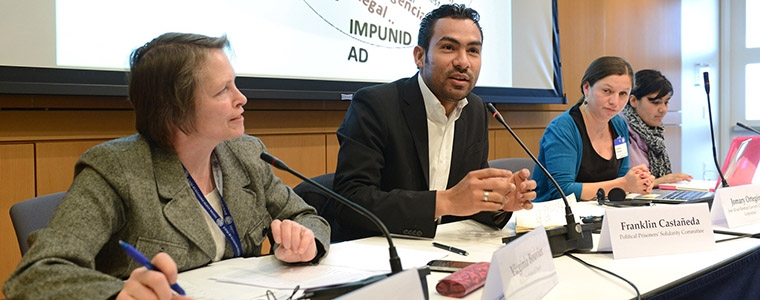
By: Virginia M. Bouvier, Lisa Haugaard and Moira Birss
Peace is more than just silencing guns. That was the upshot when Colombian human rights defenders gathered at USIP recently to discuss the ongoing peace process between the FARC guerrillas and Colombia’s government and how the talks can advance justice in the aftermath of a deal. Days later, in a development unrelated to the gathering, the Colombian government took a step in that direction.
Read more here at the USIP website.

Showing posts with label farc. Show all posts
Wednesday, April 2, 2014
Thursday, September 9, 2010
Soldiers off the hook for 2005 Peace Community massacre
Despite lots of credible evidence and international attention, Colombian government and military are officially off the hook for the February 2005 massacre in the Peace Community of San Jose de Apartado in which four adults and four children were brutally murdered. On August 18, a judge in Medellin exonerated ten members of the Colombian military who had been on trial for participation in the massacre in a more-than-100 page sentence that had me alternating between tears and sighs of frustration as I read it.
As I wrote in an article on Alternet earlier this year, the 2005 massacre case is emblematic not just as an example of the brutality suffered by civilians at the hands of the Colombian military and paramilitaries, but also of the Colombian state's efforts to maintain impunity in such cases. While the Peace Community has always insisted that the army and paramilitaries committed the crime, initially the Colombian government tried to lay blame on the victimized community itself. In fact, shortly after the massacre Colombian President Álvaro Uribe himself publicly accused the community of guerrilla collaboration, backing up army officials who claimed the FARC had committed the massacre to punish the community for collaboration gone awry. It has since been proven that army officials paid false witnesses to testify that the FARC committed the massacre.
Despite such revelations of witness buying, this ruling allows the government to again claim innocence and place blame solely on the paramilitaries. Sadly, the ruling, though extremely frustrating, is not terribly surprising, in spite of the strong evidence against the soldiers. Colombia is, after all, a country with a sky-high impunity rate (the ruling against retired Colonel Plazas Vega I wrote about recently was the first of its kind), the trial took place in a city notorious for military/paramilitary control over government institutions, and the ruling was handed down by a judge who likely received all kinds of pressure to let the soldiers off the hook.
For better or worse, a careful reading of the ruling reveals some faulty logic on the part of the judge that leaves plenty of room open for an appeal. The legal team representing the families of the victims of the massacre did an analysis of the ruling (including the very-at-risk human rights lawyer Jorge Molano, who I wrote about last year), and I’ve taken some points from that as well as added a bit of my own analysis:
As I wrote in an article on Alternet earlier this year, the 2005 massacre case is emblematic not just as an example of the brutality suffered by civilians at the hands of the Colombian military and paramilitaries, but also of the Colombian state's efforts to maintain impunity in such cases. While the Peace Community has always insisted that the army and paramilitaries committed the crime, initially the Colombian government tried to lay blame on the victimized community itself. In fact, shortly after the massacre Colombian President Álvaro Uribe himself publicly accused the community of guerrilla collaboration, backing up army officials who claimed the FARC had committed the massacre to punish the community for collaboration gone awry. It has since been proven that army officials paid false witnesses to testify that the FARC committed the massacre.
Despite such revelations of witness buying, this ruling allows the government to again claim innocence and place blame solely on the paramilitaries. Sadly, the ruling, though extremely frustrating, is not terribly surprising, in spite of the strong evidence against the soldiers. Colombia is, after all, a country with a sky-high impunity rate (the ruling against retired Colonel Plazas Vega I wrote about recently was the first of its kind), the trial took place in a city notorious for military/paramilitary control over government institutions, and the ruling was handed down by a judge who likely received all kinds of pressure to let the soldiers off the hook.
For better or worse, a careful reading of the ruling reveals some faulty logic on the part of the judge that leaves plenty of room open for an appeal. The legal team representing the families of the victims of the massacre did an analysis of the ruling (including the very-at-risk human rights lawyer Jorge Molano, who I wrote about last year), and I’ve taken some points from that as well as added a bit of my own analysis:
Tuesday, August 3, 2010
With Opposition to U.S. Militarism in Latin America on the Rise, Colombian and Venezuelan Govs Clash
Below is an article of mine published on Friday on AlterNet. It might look familiar, as it's a rework of some recent blog posts. Interesting photo they chose, huh?
On July 15 the Colombian government held a press conference to announce its possession of evidence that the Venezuelan government is harboring Colombian guerrillas, including high-ranking leaders, on Venezuela’s side of the border. The following week
Colombia’s Ambassador to the Organization of American States (OAS), Luis Alfonso Hoyos, presented to that regional body high-resolution graphics of more than 80 camps said to be housing nearly1500 guerrillas. Venezuelan president Hugo Chavez responded immediately by severing diplomatic relations and putting Venezuela’s armed forces on high alert. Over Venezuelan 20,000 troops are now stationed on the two nations’ 1250-mile border.
Before the Colombian government’s announcement it had looked as though the previously tense relations between the two countries had been warming. President-elect Juan Manual Santos invited Chavez to his inauguration, while Chavez had approved a meeting between Venezuela’s foreign minister and Santos’ minister-designate.
For Chavez, though, this crisis isn’t just about Colombia; it is also the latest example of the power of U.S. influence in Colombia. On Monday he said he considers an armed attack from Colombia “probable” and accused the U.S. government of pushing for such an attack, calling the U.S. “the great instigator.” Undeterred by the fact that the U.S. is the biggest consumer of Venezuelan oil, Chavez pledged to cut off shipments of oil to the U.S. if such an attack occurs, “even if everybody over here has to eat stones.”
Read the rest of the article here.
On July 15 the Colombian government held a press conference to announce its possession of evidence that the Venezuelan government is harboring Colombian guerrillas, including high-ranking leaders, on Venezuela’s side of the border. The following week
Before the Colombian government’s announcement it had looked as though the previously tense relations between the two countries had been warming. President-elect Juan Manual Santos invited Chavez to his inauguration, while Chavez had approved a meeting between Venezuela’s foreign minister and Santos’ minister-designate.
For Chavez, though, this crisis isn’t just about Colombia; it is also the latest example of the power of U.S. influence in Colombia. On Monday he said he considers an armed attack from Colombia “probable” and accused the U.S. government of pushing for such an attack, calling the U.S. “the great instigator.” Undeterred by the fact that the U.S. is the biggest consumer of Venezuelan oil, Chavez pledged to cut off shipments of oil to the U.S. if such an attack occurs, “even if everybody over here has to eat stones.”
Read the rest of the article here.
Thursday, July 29, 2010
Thoughts on the Colombia - Venezuela conflict
On July 15 the Colombian government held a press conference to announce its possession of evidence that the Venezuelan government is harboring Colombian guerrillas, including high-ranking leaders, on Venezuela’s side of the border. The following week Colombia’s Ambassador to the Organization of American States (OAS), Luis Alfonso Hoyos, presented to that regional body high-resolution graphics of more than 80 camps said to be housing nearly1500 guerrillas. Venezuelan president Hugo Chavez responded immediately by severing diplomatic relations and putting Venezuela’s armed forces on high alert. Over Venezuelan 20,000 troops are now stationed on the two nations’1250-mile border.
Before the Colombian government’s announcement it had looked as though the previously tense relations between the two countries had been warming. President-elect Juan Manual Santos invited Chavez to his inauguration, while Chavez had approved a meeting between Venezuela’s foreign minister and Santos’minister-designate.
For Chavez, though, this crisis isn’t just about Colombia; it is also the latest example of the power of U.S. influence in Colombia. On Monday he said he considers an armed attack from Colombia “probable” and accused the U.S. government of pushing for such an attack, calling the U.S. “the great instigator.” Undeterred by the fact that the U.S. is the biggest consumer of Venezuelan oil, Chavez pledged to cut off shipments of oil to the U.S. if such an attack occurs, “even if everybody over here has to eat stones.”
Wednesday, June 30, 2010
Fundamental Change in Colombia Unlikely with President-elect Santos
This analysis of the June 20th Colombian presidential election results was my most recent article published by the Women's iInternational Perspective.

• Juan Manuel Santos as Defense Minister. Photograph courtesy of the Center for American Progress and downloaded under a Creative Commons license. •Fulfilling expectations after a solid showing in May’s first round, former Defense Minister Juan Manuel Santos handily won Colombia's June 20th presidential run-off election. Though Santos and his contender, Antanas Mockus, the former mayor of the capital city Bogota, had been neck-in-neck in opinion polls leading up to the first round of elections, the May 30th results gave Santos a substantial lead that he never lost. On June 20th Santos won 69% of the vote.
Mockus’ defeat may be seen as a combination of several factors. For one, opinion polls are unreliable in Colombia. Pollsters tend to reach only middle and upper class urban residents. Poor and rural Colombians, who tend to not have access to landlines or other standard survey methods, are rarely surveyed.
Presumably, much of Santos’ hidden support came from the countryside. As former Defense Minister for outgoing President Alvaro Uribe, Santos represents Uribe’s hard line on security in Colombia’s decades-old internal armed conflict. Those security policies are often credited with a reduction in violence in recent years (though strong evidence indicates violence may again be on the upswing.) Santos’ direction of high-profile events like the 2008 rescue of former presidential candidate Ingrid Betancourt and three U.S. military contractors created an image of competence against the principal guerrilla group, The Revolutionary Armed Forces of Colombia (FARC.)
Read the rest of the article
• Juan Manuel Santos as Defense Minister. Photograph courtesy of the Center for American Progress and downloaded under a Creative Commons license. •
Mockus’ defeat may be seen as a combination of several factors. For one, opinion polls are unreliable in Colombia. Pollsters tend to reach only middle and upper class urban residents. Poor and rural Colombians, who tend to not have access to landlines or other standard survey methods, are rarely surveyed.
Presumably, much of Santos’ hidden support came from the countryside. As former Defense Minister for outgoing President Alvaro Uribe, Santos represents Uribe’s hard line on security in Colombia’s decades-old internal armed conflict. Those security policies are often credited with a reduction in violence in recent years (though strong evidence indicates violence may again be on the upswing.) Santos’ direction of high-profile events like the 2008 rescue of former presidential candidate Ingrid Betancourt and three U.S. military contractors created an image of competence against the principal guerrilla group, The Revolutionary Armed Forces of Colombia (FARC.)
Read the rest of the article
Monday, June 14, 2010
Hostage rescue is good news, but no excuse for impunity
Four FARC hostages were released over the weekend. While I rejoice for them and their families, I can't help feeling cynical about the timing of the release.
The rescue, code-named "Chameleon", occurred exactly two weeks before the country elects a new president. The front runner in the June 20th runoff, Juan Manuel Santos, is outgoing-president Uribe's heir apparent and served for several years as Uribe's Defense Minister, including presiding over another cinematic rescue, Operation Check, in 2008. He also presided, however, over the "false positives" scandal in which young men were captured from poor urban neighborhoods, taken to the countryside, killed, dressed up as guerrillas and claimed as combat kills. Could this latest rescue have been timed to divert attention from that macabre practice condoned under Santos' watch (and the wire-tapping scandal I wrote about recently) and generate support for his style of leadership?
This style of leadership certainly seems, after all, to seek out impunity for the military. Last week ex-Colonel Luis Alonso Plazas Vega was sentenced to thirty years in prison for his role in the disappearance of eleven people in the violent re-capture of the Justice Palace in 1985 from the now-defunct M-19 guerilla group. Now Uribe, Santos and the military leadership have been circling the wagons around Plazas Vega, claiming his sentence horrible affront to the military. Uribe made a public announcement after the sentencing claiming that the sentence "generates profound pain and disincentive among the members of the Armed Forces, responsible for protecting Colombians." The judge who handed down the sentence has since received death threats. So much for separation of judicial and executive powers, which Colombia's 1991 Constitution seeks to protect.
I do hope that I don't sound unfeeling or callous about the suffering of the FARC kidnapping victims or their families. That is an ordeal no one should have to endure, and the FARC should definitely be condemned for such a practice. In fact, for a heart-wrenching but insightful look into that experience, check out a recent episode of This American Life about being held hostage. I was on a walk listening to the podcast and nearly starting sobbing on the sidewalk during the section about the families of FARC kidnapping victims.
The rescue, code-named "Chameleon", occurred exactly two weeks before the country elects a new president. The front runner in the June 20th runoff, Juan Manuel Santos, is outgoing-president Uribe's heir apparent and served for several years as Uribe's Defense Minister, including presiding over another cinematic rescue, Operation Check, in 2008. He also presided, however, over the "false positives" scandal in which young men were captured from poor urban neighborhoods, taken to the countryside, killed, dressed up as guerrillas and claimed as combat kills. Could this latest rescue have been timed to divert attention from that macabre practice condoned under Santos' watch (and the wire-tapping scandal I wrote about recently) and generate support for his style of leadership?
This style of leadership certainly seems, after all, to seek out impunity for the military. Last week ex-Colonel Luis Alonso Plazas Vega was sentenced to thirty years in prison for his role in the disappearance of eleven people in the violent re-capture of the Justice Palace in 1985 from the now-defunct M-19 guerilla group. Now Uribe, Santos and the military leadership have been circling the wagons around Plazas Vega, claiming his sentence horrible affront to the military. Uribe made a public announcement after the sentencing claiming that the sentence "generates profound pain and disincentive among the members of the Armed Forces, responsible for protecting Colombians." The judge who handed down the sentence has since received death threats. So much for separation of judicial and executive powers, which Colombia's 1991 Constitution seeks to protect.
I do hope that I don't sound unfeeling or callous about the suffering of the FARC kidnapping victims or their families. That is an ordeal no one should have to endure, and the FARC should definitely be condemned for such a practice. In fact, for a heart-wrenching but insightful look into that experience, check out a recent episode of This American Life about being held hostage. I was on a walk listening to the podcast and nearly starting sobbing on the sidewalk during the section about the families of FARC kidnapping victims.
Monday, May 24, 2010
Amid Tensions and Surprises Colombia Prepares to Elect a New President
My latest article from The WIP, an intro to the Colombian presidential election on May 30th for those who don't regularly follow Colombian politics.

• An Earth Day campaign celebration for candidate Antanas Mockus in Medellin, Colombia. Photograph by Flickr user Sergio Fajardo Valderrama •Colombia prides itself on being Latin America’s oldest democracy. Unlike its neighbors, Colombia has not suffered brutal military coups and dictatorships and, with one brief exception, has held regular presidential elections since the mid 19th century. Nonetheless, in a country mired in internal conflict in which armed actors attempt to influence outcomes through violence, vote buying is not an uncommon practice and dozens of senators have recently been convicted of collaboration with paramilitaries. Election season in the country highlights the danger and complexity in which the country continues to live. And, as Colombians prepare to elect the successor of Álvaro Uribe, tensions are high and some surprises are surfacing.
While Uribe – who changed the country’s constitution in order to run for a second term – remains popular and is hailed by many for improving security, recent scandals tainting his presidency may be affecting the two candidates seen as his heirs, his former Defense Minister Juan Manuel Santos and Conservative Party candidate Noemí Sanín. Those scandals include both wire-tapping Supreme Court justices, journalists, and opposition politicians and extrajudicial executions – a practice in which poor young men are kidnapped from cities, taken to the countryside and shot, then dressed up in guerrilla uniforms and claimed as combat kills.
• An Earth Day campaign celebration for candidate Antanas Mockus in Medellin, Colombia. Photograph by Flickr user Sergio Fajardo Valderrama •
While Uribe – who changed the country’s constitution in order to run for a second term – remains popular and is hailed by many for improving security, recent scandals tainting his presidency may be affecting the two candidates seen as his heirs, his former Defense Minister Juan Manuel Santos and Conservative Party candidate Noemí Sanín. Those scandals include both wire-tapping Supreme Court justices, journalists, and opposition politicians and extrajudicial executions – a practice in which poor young men are kidnapped from cities, taken to the countryside and shot, then dressed up in guerrilla uniforms and claimed as combat kills.
Tuesday, January 5, 2010
Irresponsible journalism puts Peace Community at risk
January 5th update: It seems that O’Grady has been up to such reckless journalism for a while. Check out this excellent piece by Phillip Cryan from 2004.
A little less than a year ago I wrote about Peace Community fears that doctored testimony from alias Samir, a recently demobilized FARC leader from the region, would be used to discredit and harm the Community. Over the past few months those fears have been realized, mostly recently in no less than the Wall Street Journal.
On December 13th, Mary Anastasia O’Grady published a column in which she claimed, based solely on a conversation with Samir, that the Peace Community and its Colombian supporters have had close ties with the FARC. Not only that, but she makes inferences that Amnesty International and Peace Brigades International (an accompaniment organization like FOR) have supported such ties.
Now it’s no secret that I’m no fan of O’Grady’s, but I am appalled at her dangerous and irresponsible journalism. Dangerous, because in a country like Colombia, such accusations and insinuations put both Community and PBI members at risk. Irresponsible because as a veteran journalist, O’Grady should know better than to make serious assertions based upon a sole, and highly unreliable, source.
A little less than a year ago I wrote about Peace Community fears that doctored testimony from alias Samir, a recently demobilized FARC leader from the region, would be used to discredit and harm the Community. Over the past few months those fears have been realized, mostly recently in no less than the Wall Street Journal.
On December 13th, Mary Anastasia O’Grady published a column in which she claimed, based solely on a conversation with Samir, that the Peace Community and its Colombian supporters have had close ties with the FARC. Not only that, but she makes inferences that Amnesty International and Peace Brigades International (an accompaniment organization like FOR) have supported such ties.
Now it’s no secret that I’m no fan of O’Grady’s, but I am appalled at her dangerous and irresponsible journalism. Dangerous, because in a country like Colombia, such accusations and insinuations put both Community and PBI members at risk. Irresponsible because as a veteran journalist, O’Grady should know better than to make serious assertions based upon a sole, and highly unreliable, source.
Wednesday, September 30, 2009
Colombia’s War: “He’s giving our country away”
Check out my newest article, published on a great international women's journalism site, The WIP.
The sparse media coverage of Colombia tends only to give vague descriptions of a violent country with a thriving drug trade. But I’ve come to understand in my 15 months living and working here as a human rights observer and accompanier, that, like many armed conflicts in the world, the war continues because it serves the interests of the rich and powerful, from the Uribe administration to multinational corporations.
Despite its claims to the contrary, the Colombian government’s policies do little to end the violence. Spanning over nearly five decades and multiple administrations, the internal conflict has resulted in countless deaths and over 4 million internally displaced Colombians.
Monday, August 10, 2009
"Witness" paid to testify against Peace Community
Last week the demobilized paramilitary known as "HH" testified that he gave money to the Colombia army to in order to bride demobilized guerrillas into claiming that the FARC was responsible for the February 2005 massacre in which eight members of the Peace Community of San José de Apartadó were brutally murdered.
From the moment Peace Community members learned of the massacre, in which 8 Community members, including a 21-month-old baby, were killed and dismembered, they attributed the crime to the Colombian military in cooperation with paramilitaries. The government and the army’s 17th Brigade, which operates in the region of Apartadó, were quick to refute the denouncement, instead accusing the Community of collaborating with the FARC and attributing the crime to the very same guerrillas. It was not until 2008, when paramilitaries and subsequently army officials started confessing their role in the massacre that the government began to admit that perhaps the guerrillas weren't responsible after all.
The testimony of HH, whose real name is Ever Velosa García, however, is key because it not only reconfirms the role of the military and paramilitaries but also demonstrates the lengths that military officials have and will go to cover up their crimes and discredit those who oppose them. In his testimony HH describes how he was asked for money by then-coronel Néstor Iván Duque López to pay demobilized FARC guerrillas: “On that occasion, he went with a bunch of papers and told me that he was defending himself from some denouncements from San José de Apartadó and asked me to give him 2 million pesos [about a thousand dollars at current exchange rates] to give to some witness who were going to testify about the massacre of San José de Apartadó,” Velosa testified to Colombia’s Attorney General’s office.
Monday, June 1, 2009
A stranger in our midst
The arrival the other day of a stranger to the caserío of La Unión reminded me of how much this conflict distorts human relations and making people suspicious and fearful of each other.
As usual, those of us in the FOR house (read: the gringos) hadn’t even noticed that a stranger had been hanging around since 10am until two of the community’s internal council members came to the house in the afternoon requesting accompaniment to go speak with the man. (Our obliviousness was likely due to two things: we don’t know each and every family member or long-lost neighbor in this area, so it’s not uncommon for someone who is a stranger to us to pass through, and, despite our training as accompaniers, we aren’t as finely attuned to the subtle daily changes around here.)
Around here, everyone pretty much knows everyone, and this isn’t exactly and easily accessible place (see my post on my commute!), so strangers don’t just tend to wander by. The stranger’s presence here soon raised alarm bells, and a few particularly threatened individuals event went so far as to hide in their beds under the blankets. By the afternoon when he still hadn’t left – in fact, he had been wandering around a bit, raising even more suspicion – the council members asked us to accompany them to talk to him in the kiosko (central community meeting space, covered by a round palm-thatched roof), where he had been hanging out for the previous hour or so. The community members with whom we discussed the incident before heading to the kiosko were quite worried and very visibly shaken up.
As usual, those of us in the FOR house (read: the gringos) hadn’t even noticed that a stranger had been hanging around since 10am until two of the community’s internal council members came to the house in the afternoon requesting accompaniment to go speak with the man. (Our obliviousness was likely due to two things: we don’t know each and every family member or long-lost neighbor in this area, so it’s not uncommon for someone who is a stranger to us to pass through, and, despite our training as accompaniers, we aren’t as finely attuned to the subtle daily changes around here.)
Around here, everyone pretty much knows everyone, and this isn’t exactly and easily accessible place (see my post on my commute!), so strangers don’t just tend to wander by. The stranger’s presence here soon raised alarm bells, and a few particularly threatened individuals event went so far as to hide in their beds under the blankets. By the afternoon when he still hadn’t left – in fact, he had been wandering around a bit, raising even more suspicion – the council members asked us to accompany them to talk to him in the kiosko (central community meeting space, covered by a round palm-thatched roof), where he had been hanging out for the previous hour or so. The community members with whom we discussed the incident before heading to the kiosko were quite worried and very visibly shaken up.
Thursday, March 19, 2009
Accumulation by dispossession
I frequently get asked by friends and family outside of Colombia about the hows and the whys of the armed conflict here. Most folks outsiders have heard that there’s some sort of war here, and know that drugs is somehow related, but that tends to be the extent of their knowledge.
What I’ve come to understand more deeply since being here is that – like most armed conflicts in the world – the Colombian conflict continues because it serves the interests of the rich and powerful (Iraq, anyone?). The government does not, in fact, really try that hard to end the violence. Instead, it exploits the conflict, using it to further its desires to enrich its land-holding and multinational corporation-owning friends. President Uribe, himself the owner of vast expanses of land in the Urabá region, has been particularly interested in and efficient at such enrichment for himself and his cronies. I think it’s safe to say that the government isn’t even really that interested in completely getting rid of the guerrillas, because they serve the role as the enemy that justifies the war. At the same time, the guerrillas and narco-paramilitaries themselves are often happy to push people off their land in order to cultivate coca and generally control territory.
War is profitable and beneficial in obvious ways for the military-industrial complex: in generates income and employment for the arms manufacturers, the military and police, intelligence agencies and the companies that supply such equipment, etc. In the case of Colombia, though, it also provides a way gain control of another source of vast riches: the incredibly fertile Colombian land and the natural resources – copper, oil, carbon, emeralds etc. – that abound. Displacement (see previous post for more on displacement) of the rural population from its land as a result of the violence is not just an unfortunate accident of the violence. Uruguayan journalist Raúl Zibechi calls it “accumulation by dispossession.”
What I’ve come to understand more deeply since being here is that – like most armed conflicts in the world – the Colombian conflict continues because it serves the interests of the rich and powerful (Iraq, anyone?). The government does not, in fact, really try that hard to end the violence. Instead, it exploits the conflict, using it to further its desires to enrich its land-holding and multinational corporation-owning friends. President Uribe, himself the owner of vast expanses of land in the Urabá region, has been particularly interested in and efficient at such enrichment for himself and his cronies. I think it’s safe to say that the government isn’t even really that interested in completely getting rid of the guerrillas, because they serve the role as the enemy that justifies the war. At the same time, the guerrillas and narco-paramilitaries themselves are often happy to push people off their land in order to cultivate coca and generally control territory.
War is profitable and beneficial in obvious ways for the military-industrial complex: in generates income and employment for the arms manufacturers, the military and police, intelligence agencies and the companies that supply such equipment, etc. In the case of Colombia, though, it also provides a way gain control of another source of vast riches: the incredibly fertile Colombian land and the natural resources – copper, oil, carbon, emeralds etc. – that abound. Displacement (see previous post for more on displacement) of the rural population from its land as a result of the violence is not just an unfortunate accident of the violence. Uruguayan journalist Raúl Zibechi calls it “accumulation by dispossession.”
Wednesday, February 18, 2009
Indigenous massacre demonstrates cycle of violence
As the news arrived here to the Peace Community, shock and sadness were accompanied by doubt about the media and government’s attribution of the crime to the FARC. Several community members commented that they figured the Uribe administration wanted to accuse the FARC in order to stymie calls for the negotiation of a humanitarian accord after the recent unilateral release of 6 hostages held by the FARC. Such doubt is not just general skepticism about the government’s constant quickness to blame the FARC for nearly any and all crimes committed in the country. When the Peace Community suffered it’s own massacre of 8 community members in 2005, the Uribe administration immediately blamed the FARC. The community maintained that paramilitaries in collaboration with the army were the perpetrators, and finally, years later, soldiers and paramilitaries are confessing their responsibility for the crime.
Friday, July 11, 2008
On the Hostage Rescue
I've been both very busy in the last week and a half and not near internet, so haven't had time to post here, but given all the questions I've been getting about the rescue of the 15 hostages from the FARC, I thought it would be good to check in and make a few comments.
First, I am fine and we are not all that worried that the rescue will have negative repercussions for us and our work. Thanks for your concern!
Second, some comments on the rescue:
It is absolutely fantastic that the 15 hostages were freed and are back at home with their families, and I am so glad that their suffering at the hands of the FARC is over. However, like I did with my last post about Uribe, I'd like to mention a few related items that aren't getting as much attention.
First, I am fine and we are not all that worried that the rescue will have negative repercussions for us and our work. Thanks for your concern!
Second, some comments on the rescue:
It is absolutely fantastic that the 15 hostages were freed and are back at home with their families, and I am so glad that their suffering at the hands of the FARC is over. However, like I did with my last post about Uribe, I'd like to mention a few related items that aren't getting as much attention.
Subscribe to:
Posts (Atom)