Showing posts with label us policy. Show all posts

Wednesday, April 2, 2014

Peace Is More than Silencing Guns: Human Rights and Colombia’s Peace Process

By: Virginia M. Bouvier, Lisa Haugaard and Moira Birss 


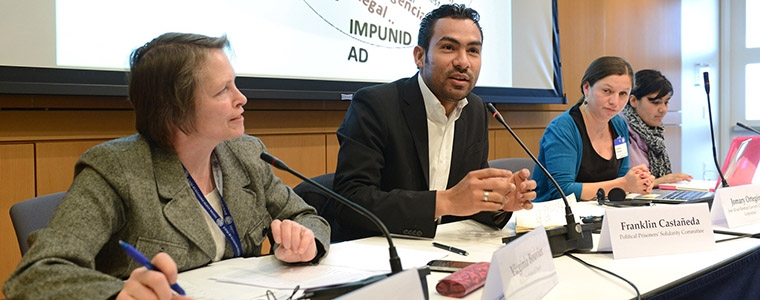
Peace is more than just silencing guns. That was the upshot when Colombian human rights defenders gathered at USIP recently to discuss the ongoing peace process between the FARC guerrillas and Colombia’s government and how the talks can advance justice in the aftermath of a deal. Days later, in a development unrelated to the gathering, the Colombian government took a step in that direction.

Read more here at the USIP website.

Friday, December 10, 2010

The Hidden Side of Violence in Ciudad Juárez: Student Shot by Federal Police

This article was published today on The Women's International Perspective, where I have previously published several articles about Colombia. It's similar to the previous post, but geared at a wider audience. Enjoy!


A mural worked on by Juárez artists during the Foro. The left side is a depiction of civil society. The right depicts death and destruction by the federal forces and other violent actors. Photograph courtesy of the author.
“Ciudad Juárez won’t be a big deal. You spent two years in Colombia!” my friend reassures me.
“Yeah,” I reply with nervous knots in my stomach, “but isn’t Juárez one of the most dangerous cities in the world?”

The violence wracking Mexico, largely fueled by the country’s drug war, is magnified in the border town of Ciudad Juárez, just across the Rio Grande from El Paso, Texas. So even though I spent two years as a human rights accompanier in Colombia visiting some of the country’s most dangerous regions, the concentration and apparent randomness of the violence in Juárez left me apprehensive about my upcoming trip.

Just days before my departure the last weekend in October, four maquila factory workers were killed and fifteen more injured when gunmen shot up three company buses carrying the workers home. The following weekend, 20 more were killed. Since 2008, the murder rate has surpassed 6,500 in a city of about 1.5 million.

Tuesday, November 23, 2010

My trip to Ciudad Juarez: A glimpse into the hidden side of Mexico’s violence

I wrote this piece for the latest Colombia Update from the Fellowship of Reconciliation, the organization I worked with in Colombia.

mural in Juarez1
A mural painted by Foro participants
When FOR staff asked if I could travel to a conference on civilian resistance to militarism in Ciudad Juarez, Mexico during the last weekend in October, I jumped at the chance to visit a country often compared to Colombia, where I recently spent two years as a human rights accompanier.

However, as my departure date grew closer, I became more and more nervous. The violence wracking Mexico, largely fueled by the country’s drug war, is magnified in the border town of Juarez, just across the Rio Grande from El Paso, Texas, and often vies for the dubious title of most dangerous city in the world. So just because I spent two years in Colombia as a human rights accompanier, and knew that the mainstream news stories about Mexico I had read didn’t tell the whole story, the concentration and apparent randomness of the violence in Juarez, at least as portrayed in mainstream media, worried me.

Just days before my departure for Ciudad Juarez, for example, four maquila factory workers were killed and fifteen more injured when gunmen shot up three company buses carrying the workers home. Since 2008, the number of murders has surpassed 6,500 in a city of about 1.5 million. New York City, with a population of 8.3 million, had just 1,570 murders in a similar period.

Friday, November 19, 2010

Latin American Peoples Organize to Resist Increased Militarization in the Region

My article, originally published on War Times

Wednesday, August 18, 2010

Don’t Call it a Model: The Failures of Plan Colombia

I had been planning to post about U.S. officials' erroneous use of Plan Colombia as a model for countries like Mexico and Afghanistan. But Adam Isacson of the Washington Office on Latin American beat me to it, and did an excellent job, so I decided to repost it. 

Don’t Call it a Model

On Plan Colombia's tenth anniversary, claims of “success” don't stand up to scrutiny

Download the printer-friendly PDF version of this report (515 KB).

(Written by Adam Isacson, Senior Associate for Regional Security Policy, Washington Office on Latin America)

On July 13, 2000, President Bill Clinton signed into law a $1.3 billion package of mostly military aid, known as “Plan Colombia,” that made Colombia by far the biggest U.S. aid recipient outside the Middle East. Now, ten years later, Colombia often gets described as a “success” in Washington. Officials and analysts point to improvements in several measures of security in the conflict-torn South American country. They give the credit to U.S. assistance and to President Álvaro Uribe, who took over in 2002 and implemented a hard-line security policy.

Looked at more closely, though, Colombia’s security gains are partial, possibly reversible, and weighed down by “collateral damage.” They have carried a great cost in lives and resources. Progress on security has been stagnating, and even reversing. Scandals show that the government carrying out these security policies has harmed human rights and democratic institutions. Progress against illegal drug supplies has been disappointing. And wealth is being concentrated in ever fewer hands.

What Colombia has done is worth learning from. But since it favors military force while neglecting both civilian governance and impunity, it is not a model to be applied in Afghanistan, Mexico, or anywhere else. Colombia's new government and U.S. policymakers face an ever more urgent need to change it.

Tuesday, August 3, 2010

With Opposition to U.S. Militarism in Latin America on the Rise, Colombian and Venezuelan Govs Clash

Below is an article of mine published on Friday on AlterNet. It might look familiar, as it's a rework of some recent blog posts.  Interesting photo they chose, huh?

On July 15 the Colombian government held a press conference to announce its possession of evidence that the Venezuelan government is harboring Colombian guerrillas, including high-ranking leaders, on Venezuela’s side of the border. The following week Colombia’s Ambassador to the Organization of American States (OAS), Luis Alfonso Hoyos, presented to that regional body high-resolution graphics of more than 80 camps said to be housing nearly1500 guerrillas. Venezuelan president Hugo Chavez responded immediately by severing diplomatic relations and putting Venezuela’s armed forces on high alert. Over Venezuelan 20,000 troops are now stationed on the two nations’ 1250-mile border.

Before the Colombian government’s announcement it had looked as though the previously tense relations between the two countries had been warming. President-elect Juan Manual Santos invited Chavez to his inauguration, while Chavez had approved a meeting between Venezuela’s foreign minister and Santos’ minister-designate.

For Chavez, though, this crisis isn’t just about Colombia; it is also the latest example of the power of U.S. influence in Colombia. On Monday he said he considers an armed attack from Colombia “probable” and accused the U.S. government of pushing for such an attack, calling the U.S. “the great instigator.” Undeterred by the fact that the U.S. is the biggest consumer of Venezuelan oil, Chavez pledged to cut off shipments of oil to the U.S. if such an attack occurs, “even if everybody over here has to eat stones.”

Read the rest of the article here.

Thursday, July 29, 2010

Thoughts on the Colombia - Venezuela conflict

On July 15 the Colombian government held a press conference to announce its possession of evidence that the Venezuelan government is harboring Colombian guerrillas, including high-ranking leaders, on Venezuela’s side of the border. The following week Colombia’s Ambassador to the Organization of American States (OAS), Luis Alfonso Hoyos, presented to that regional body high-resolution graphics of more than 80 camps said to be housing nearly1500 guerrillas. Venezuelan president Hugo Chavez responded immediately by severing diplomatic relations and putting Venezuela’s armed forces on high alert. Over Venezuelan 20,000 troops are now stationed on the two nations’1250-mile border. 

Before the Colombian government’s announcement it had looked as though the previously tense relations between the two countries had been warming. President-elect Juan Manual Santos invited Chavez to his inauguration, while Chavez had approved a meeting between Venezuela’s foreign minister and Santos’minister-designate.

For Chavez, though, this crisis isn’t just about Colombia; it is also the latest example of the power of U.S. influence in Colombia. On Monday he said he considers an armed attack from Colombia “probable” and accused the U.S. government of pushing for such an attack, calling the U.S. “the great instigator.” Undeterred by the fact that the U.S. is the biggest consumer of Venezuelan oil, Chavez pledged to cut off shipments of oil to the U.S. if such an attack occurs, “even if everybody over here has to eat stones.”

New Report: U.S. Aid for Civilian Murders

The following is a release from the Fellowship of Reconciliation of an explosive new report released today.

This week, the Wikileaks "Collateral Murder" scandal has rocked the world. Its explosive findings have described a U.S. military unaccountable to its own nation's laws and human rights policy, including the deaths of hundreds of innocent Afghans. Now today, a detailed report by the Fellowship of Reconciliation (FOR) and U.S. Office on Colombia describes how several years of U.S. funding to the Colombian military has supported army units directly responsible for at least a thousand murders of unarmed civilians.


Drawing on extensive data from the U.S. State Department, Colombian government and military, and human rights organizations, the report shows that massive military training, equipment, and intelligence provided under the rubric of "Plan Colombia" have violated U.S. human rights law and contributed to illegal killings. Next month, Colombia's human rights status will be reviewed by the State Department: Tell Secretary Clinton today to withhold Colombia's certification.

"The U.S. has provided more than $6 billion in military aid to Colombia since 2000," said John Lindsay-Poland, FOR's research and advocacy director. "This money is used to support military units that have been proven to murder innocent civilians. That is outrageous and needs to stop." U.S. law prohibits support to any foreign military unit for which there is credible evidence of having committed gross human rights violations, such as extrajudicial killings.

This forceful study also has serious implications for Pakistan, where the United States has spent more than $12 billion in military assistance and where human rights groups have reported hundreds of extrajudicial killings. The U.S. Congress, State Department, and National Security Council must take action to ensure U.S. tax dollars no longer bankroll militaries that carry out illegal executions in Colombia, Pakistan, Afghanistan, Mexico, or any other country! Act today: Call on Secretary of State Hillary Clinton to decertify Colombia's human rights status.

Read the full report, executive summary, and see special maps of U.S. aid and rights violations: Military Assistance and Human Rights: Colombia, U.S. Accountability, and Global Implications

Sunday, July 25, 2010

Opposition mounts to increased U.S. military presence in Latin America

Last year I published several articles about the U.S.-Colombia agreement for U.S. use of seven Colombian air and military bases. As I wrote in those articles, opposition quickly mounted to the agreement from unions, opposition political parties, human rights groups, and more, for reasons as varied as worries over increasing regional tensions, U.S. personnel's legacy of sexual abuse in foreign outposts, and questions of legality.

Now, Colombia's Constitutional Court itself is stepping into the fray with its own concerns. In a draft opinion released Friday, Judge Jorge Ivan Palacios urged his colleagues to declare the bases agreement invalid and send the agreement to Congress for a chance to approve or reject it. Though the Court will not officially rule on the case brought by the José Alvear Restrepo legal collective until August 17, this draft opinion directly challenges President Alvaro Uribe's assertion that the agreement isn't actually a treaty and therefore does not require Congressional approval as dictating by Colombian law. If the Court follows Judge Palacio's suggestion, it will confirm a non-binding ruling by the State Council, and advisory body, that urged compliance with the Colombian law requiring Congressional approval of treaties.

Meanwhile, opposition to increasing U.S. military presence continues to mount in the region. When  the earthquake hit Haiti, the strong U.S. military contingent sent to the ravaged island large numbers. Then in July, the U.S. deployed 46 warships and 7,000 marines to military-less Costa Rica.

Thursday, June 17, 2010

See for yourself: Military Bases, Human Rights & Free Trade Delegation

Last Chance to Apply! There are still a few spaces left on this unprecedented delegation, taking place July 24 - August 2, hosted by Fellowship of Reconciliation and Witness for Peace.
Last fall, the governments of Colombia and the United States signed an agreement to grant the Pentagon use of seven military bases on Colombian soil. The agreement bolstered the United States' military presence in the Andean region at a time when progressive movements in Ecuador, Venezuela and Bolivia struggle to reorganize their societies more equally, and victims of Colombia's dirty war demand accountability. It also intensified the contentious mix of militarism and free trade that has characterized U.S. Latin American policy. 
What role do the bases play in upholding free trade orthodoxy and advancing the counterinsurgency, anti-narcotics program known as Plan Colombia? How does the increasing militarization of Colombia affect grassroots politics? 

JOIN THE FOR & WFP AS THEY EXPLORE THESE ISSUES IN COLOMBIA. Delegation participants will:
  • Visit several U.S. military bases
  • Talk with Colombians who live and work near the bases
  • Meet with human rights, labor, peasant, and community groups
  • Meet with U.S. and Colombian government and military personnel
DELEGATION LEADERS: The delegation will be led by Susana Pimiento Chamorro and by Lesley Gill (Ph.D. 1984, Columbia); Vanderbilt U., Department Chair, Anthropology. Lesley's research in Latin America focuses on political violence, human rights, global economic restructuring, the state, and transformations in class, gender, and ethnic relations. Her books include The School of the Americas: Military Training and Political Violence (Duke, 2004). Susana Pimiento is a Colombian-American attorney who co-directs Fellowship of Reconciliation's Task Force of Latin America and the Caribbean. Based in Bogotá, she has undertaken research on military bases and played a very active role in the formation of the Colombia No Bases Coalition.

CONTACTS: Lesley Gill 615-322-2851, Lesley.gill@att.net
Ken Crowley 202-423-3402, ken@witnessforpeace.org
 
COST: Full Delegation Cost $1,225

Wednesday, April 28, 2010

SF event: My report-back from Colombia

If you're in the Bay Area, come hear me speak about my time in Colombia!

Paramilitaries, Privilege, and Papaya: Two years as a human rights observer in Colombia

Tuesday, May 4 @ 6-8pm
Make-Out Room
3225 22nd St (at Mission)
Light snacks served

An evening with Moira Birss, who just returned from two years working with the Fellowship of Reconciliation Colombia Program as an human rights observer in San Jose de Apartado and Bogota, Colombia to support communities and organizations that nonviolently resist war and displacement in the context of Colombia's decades-long conflict.

For more information, contact FOR: 510.763.1403, www.forcolombia.org

Wednesday, April 14, 2010

Speaking of snitches, it looks like Uribe's one, too

April 21 note: A version of this post was published on Alternet under the title "Chilling": Colombian President Alvaro Uribe's Spying Program Targeted Judges and Journalists. Check it out!

In my latest article I described Colombian President Alvaro Uribe's efforts to engage Colombians in a civilian spy network. Solid evidence from the Attorney General's office now demonstrates what many - myself included - suspected: Uribe was doing plenty of spying of his own.

During the trial of five current and former functionaries of the Departamento Administrativo de Seguridad (DAS, the intelligence agency that reports directly to the president) accused of illegally spying on journalists, Supreme Court justices, and human rights defenders, an investigator from the Attorney General's office presented detailed evidence that the illegal surveillance of the Supreme Court  was directed from no less than the Casa de Nariño (Colombia's White House).

Among the evidence presented by the investigator on Saturday was a folder labeled "President Uribe," used to collect documents of "special interest" to the president, as well as transcriptions of private meetings and sessions of the high court that were secretly recorded by the intelligence agency. Evidence also included witness' descriptions of secret meetings in which DAS functionaries were delegated tasks for spying on the justices. The witnesses named several high-level presidential advisors who participated in many of these meetings.

Saturday, November 7, 2009

Bases deal signed, but what are the real intentions?

November 16 update: Another version has been published on Alternet.org under the title “Obama Signs Military Basing Deal with Colombia -- Could Set Stage for Expeditionary Warfare.”
November 11 update: A version of this piece has been published on CommonDreams.org under the title "Signing of Colombia Bases Deal Could Set the Stage for 'Expeditionary Warfare'".

After several months of secrecy and controversy, on October 28th the US and Colombia signed an agreement to allow the US military extensive access to seven Colombian bases, notwithstanding serious concerns about true intentions and eventual consequences.

Despite pledges by Colombian and U.S. governments about the limitations of the agreement, the agreement text and U.S. military documents contradict such assurances. One of the principal concerns raised by regional governments after news was leaked of the pending agreement has been the possibility of the bases’ use for aggressions against neighboring countries. In an interview Sunday with the Colombian daily El Tiempo, Ambassador Brownfield claimed that joint operations aren’t planned outside of Colombia, and that Article IV of the agreement expressly forbids such operations. In fact, a careful review of the text of the agreement reveals no such prohibition.

Not only that, but similar assurances by Colombian Defense Minister Gabriel Silva that the agreement "has no geopolitical or strategic connotation, other than being more effective in the fight against drug trafficking" are even more hard to believe after reading a recently-uncovered Pentagon budget document that expresses clear regional intentions for the Palanquero base. The document describes the U.S. presence in Palanquero as an “opportunity for conducting full spectrum operations throughout South America,” and confirms the fears of Colombia’s neighbors when it discusses the possibility of using the base to confront the "threat" of what it calls "anti-US governments." The most chilling phrase, however, is the discussion of the potential use of Palanquero to “expand expeditionary warfare capability.”

Wednesday, September 30, 2009

Colombia’s War: “He’s giving our country away”

Check out my newest article, published on a great international women's journalism site, The WIP.

The sparse media coverage of Colombia tends only to give vague descriptions of a violent country with a thriving drug trade. But I’ve come to understand in my 15 months living and working here as a human rights observer and accompanier, that, like many armed conflicts in the world, the war continues because it serves the interests of the rich and powerful, from the Uribe administration to multinational corporations.

Despite its claims to the contrary, the Colombian government’s policies do little to end the violence. Spanning over nearly five decades and multiple administrations, the internal conflict has resulted in countless deaths and over 4 million internally displaced Colombians.

Read the rest of the article

Wednesday, September 9, 2009

Counter-tourism, international campaign & letter to Obama

While the Colombian Government has launched a public relations campaign, "Discover Colombia Through Its Heart," complete with enormous heart sculptures placed in downtown D.C., a group of activists has responded with its own "counter-tourism" campaign. Offering "exploitation opportunities and luxuriously abusive vacation packages," the campaign's site describes how "as a visitor to Colombia, you will be overwhelmed by legendary Colombian hospitality. You may even be fortunate enough to receive the same 'red carpet treatment' given to some Colombian citizens by the army -- literally rolled up in a red carpet and shipped across the country! These no-cost excursions start with kidnapping, continue with being trucked hundreds of miles to a more violent frontier region and end with extrajudicial execution and a press conference announcing 'positive' kills of guerrilla fighters." The website and various direct actions are part of a larger counter-campaign, No More Broken Hearts.

Love it!

Also launched this week is an international campaign to defend the right to defend human rights in Colombia. Coinciding with the visit of the UN Special Rapporteur for Human Rights Defenders, the campaign launched yesterday at an event in downtown Bogotá. "In Colombia, being a human rights defender is a dangerous, often deadly job," says the campaign website. "And things are getting worse."

Lastly, we are asking folks in the U.S. to urge their representatives to sign a letter to President Obama. The letter expresses concern about the plan for 7 U.S. military installations in Colombia. Please take action!

Saturday, August 15, 2009

US & Colombia Rush Negotiations For Seven Military Bases As Dissent Grows

You live in a nice house in a tense neighborhood. Your neighbors haven’t been too pleased with you lately, and you have a terrible roach infestation running havoc in your house. But perhaps there’s hope. A big, strong guy lives down the street, and is offering to help out. He has big guns and says he has just the spray to get rid of those pesky roaches if you just let him crash at your place.

I’m not the first to have used the tough-neighbor analogy when discussing a current p
roposal for seven US military bases in Colombia, but others have failed to mention all the problematic side effects of inviting the neighbor to stay. This neighbor has a very sketchy reputation and just may try to take advantage of your sister, not to mention raid your fridge and clog up your toilet. His presence will really upset your neighbors, even the ones with whom you have been friendly. Though he says he’s only staying at your house to help with the roaches and maybe intimidate the troublesome folks next door a bit, he always seems to get involved in other things: he traipses around in the neighbors’ gardens and hassles his host’s family members. Besides, his record in getting rid of the roaches isn’t all that exemplary. Is it really worth it?

Perhaps this analogy simplifies matters too much, but I’m not the only one playing with rhetoric. Obama continues to defend the bases proposal, arguing that the U.S. is not establishing bases in Colombia but simply extending existing agreements with the country. Under U.S. military terminology – using euphemisms that call to mind Bush's "Clear Skies Initiative" - the proposals for Colombia would not be bases because they would not be property of the U.S, but instead be called Forward Operating Locations or Cooperative Security Locations. Nonetheless the U.S. would still have control over what happens in those installations, as it does in bases, and is insisting on immunity for its personnel under Colombian law. Argentine president Cristina Kirchner said it well when she joked to Uribe last week, “Come on, nowhere in the world is a General Fernandez going to give orders to a General Johnson!”

Wednesday, July 29, 2009

5 new US military bases in Colombia is hardly a move to the left

The Wall Street Journal’s Mary Anastasia O’Grady never ceases to give me fodder for blog posts! In Monday’s edition, she claims that the Obama administration's Latin America policy is being pulled to the left by White House Counsel Greg Craig. It’s no secret that I am much farther left on the political spectrum than O’Grady, so am probably biased, but I can't help but be befuddled by her assertion.

O'Grady bases her claim largely on the fact that the Obama administration has called for the reinstatement of ousted Honduran President Manual Zelaya, who was overthrown while purportedly trying to change the constitution to allow him to stay in office longer. Hmm, remind you of a leader a bit farther south, in, say, Colombia? But if a coup overthrew Colombian president Alvaro Uribe, who has also been trying to change the constitution to stay in office longer, O’Grady would be up in arms to restore him. Besides, Obama isn't actually too firm in his support of Zelaya.

Putting aside that double standard, however, it’s clear O’Grady hasn’t been keeping up to date with current events. If she had, she would have heard about negotiations underway between the U.S. and Colombia to establish at least 5 U.S. military bases in Colombia. Last I heard, folks on the left tend to oppose increased militarization; it's tough to see 5 new military bases as a move to the left.
Why is the administration pushing for these bases? The stated goal of the military facilities is "filling the gaps left by the eventual cutting of [military] aid in Plan Colombia," according to sources in Washington and Bogotá cited by an article published July 1 in the Colombian weekly news magazine Cambio.

Sunday, May 10, 2009

See first-hand what I write about: August delegation to Colombia


Visit the Peace Community and other organizations working to peacefully end the armed conflict in Colombia, and hang out with me! I'll be helping lead this delegation, so can promise that it will be fantastic.
:)

August 15-29, 2009
Delegation to San José Peace Community, Medellín and Eastern Antioquia

Witness the incredible commitment and experience of the Peace Community of San José and other Colombian grassroots initiatives. $1500 from Bogotá. For information contact John Lindsay-Poland, johnlp@igc.org. To download an application, please click here.

2009 FOR Delegation to Colombia Program Highlights:

  • Travel to the Peace Community of San José de Apartadó
  • Meet with people whose family members have been killed by the US-funded Colombian army and are non-violently working for justice for these crimes.
  • Meet grassroots activists who courageously and creatively advocate for truth, justice and integral reparations.
  • Experience unparalleled access to understand both impunity and advances to justice for a massacre in San José that shocked the international community.
  • Understand the U.S. media blanket on Colombia and get a glimpse of the side of Colombian life that rarely arrives to the U.S.

Witness the incredible commitment and experience of the Peace Community of San José and other Colombian grassroots initiatives. $1500 from Bogotá. For information contact John Lindsay-Poland, johnlp@igc.org. To download an application, please click
click here.

Wednesday, March 11, 2009

Who isn't the government illegally tapping?

I recently returned from vacation, hence the lack of blog posts. I therefore post below a note from FOR's most recent Colombia newsletter about the latest intelligence scandal in Colombia. My addition is the too-unbelievable-for-fiction fact that Uribe government officials, rather than calling for a full investigation, have insinuated that because Semana, a widely-regarding news magazine, uncovered the story, it has ties to the guerrillas.

Less than two months after the interception of FOR's email - along with other 150 email accounts - was revealed, a new scandal of spying on opposition emerged during the last weekend of February. The weekly magazine Semana uncovered a massive wiretap operation carried out by the Department of Administrative Security (DAS), the Colombian secret police that answers directly to the President.

The targets this time included Supreme Court Justices who are investigating members of Congress close to President Uribe, including his cousin Mario Uribe. The Uribe government have fiercely attacked several of those justices, accusing them of "engaging in witness trafficking" and political persecution. Over the past 18 months, the justices and their families have also been targeted for harassment, including one whose home was broken into with just a laptop stolen.

Ivan Velásquez, the justice handling the parapolitica investigation, reportedly had more than 1,900 phone calls intercepted in a three-month period and has been subject to a "man to man" surveillance. In October 20007, "Tasmania," a right wing paramilitary leader, was reportedly bribed to falsely accuse Velásquez of manipulating testimony. No one has been charged for any of the attacks on the justices.