Showing posts with label daily life. Show all posts

Saturday, May 21, 2011

Hello again, again from Bogota

It’s been a while since my last post, hasn’t it? My excuse for that is the recent rash of big changes in my life: a return to the U.S. after my four month stint back as an accompanier with Fellowship of Reconciliation, a fabulous new job with Peace Brigades International’s Colombia project, and my move across the country from San Francisco to D.C.

As I write this, I've just arrived in Colombia, again. As the new Communications and Outreach Officer (I know, a kinda long title) for PBI Colombia, I’ll be participating in the project’s yearly assembly in Bogota during the next couple weeks, then conducting site visits to several of the field teams. PBI is a human rights accompaniment organization like FOR but on a much larger scale, with field teams in Bogota, the petroleum region of Barrancabermeja, the Uraba region where I spent my first year with FOR, the city of Medellin, and an in-process expansion to the southern city of Cali. 

The move to D.C. has gone smoothly, all things considered. D.C. has never been a place I’d had a hankering to live in; in fact, until really recently I more or less refused to look at D.C.-based job postings and bemoaned what I thought of as the "Beltway bubble". But then this job came along, allowing me to continue doing the work I love of supporting communities and organizations in Colombia doing incredible and inspiring human rights work, and I couldn’t pass it up. Besides, PBI is unique among most organizations with D.C. offices in that our staff is overwhelmingly based in-country, which helps keep me out of, or at least on the very edge of, the Beltway bubble.

Given my new job, I’ll be continuing to write about human rights in Colombia, but from a style a bit different than you’re likely used to from my previous posts and articles: it will be more about the communities and organizations PBI accompanies and the problems they face and less direct political analysis. As always, I’d love your feedback, and suggest you also check out PBI Colombia’s blog, where I will be editing and, at times, writing, as well as our Facebook page.

Thanks for your support!

Tuesday, April 5, 2011

Resisting Violence through Sustainable Agriculture in Colombia

This article originally appeared on The Women's International Perspective.


A hand-made sign lists 12 varities of bananas grown in the Peace Community of San José de Apartadó. Photograph courtesy of the author.
In the middle of one of the most fertile regions in Colombia, amidst a five-decade armed conflict, a small peasant community manages to serve as a model of civilian resistance against violence and displacement. But as I saw when I returned in February to the Peace Community of San José de Apartadó, located in the northwestern province of Antioquia, their sustainable agriculture projects not only defend against violence but also create life.

“These are proyectos de vida, explains Javier, the Community member who manages the Community’s new agriculture center. These projects of life, as the name indicates, are more than an effort to reduce the Peace Community’s ecological footprint, to eat locally, and to reduce reliance on outside food sources. They are called proyectos de vida because they also serve as a survival mechanism against violence and a strategy against displacement.

With nearly two hundred Peace Community members killed since 1997 and thousands of human rights violations committed by guerrilla, paramilitary, and state armed forces, the Peace Community’s survival depends on a constant struggle to defend life. “We have to create our own principles and laws about land, and collectively defend the land,” Javier explains to me on my recent visit. “It is because of resistance, collectivity, and community that we have managed to stay.”

The Peace Community developed the agriculture center in the last year to serve as a hands-on agricultural research and learning facility for the development of food self-sustainability. The center includes a plant nursery, medicinal plant garden, worm bin for composting, and several acres dedicated to experimenting with the various varieties of crops grown in the region such as a banana field with 12 varieties of the fruit. Springs are being protected in order to conserve water sources, some of which feed into fish breeding ponds.

“Many peasants believe that what comes from outside is better than what we have. But no,” explains Javier. “That is why we have been working so hard in the agriculture center…to care for [what we have] and [to learn] how to care for our own resources, including farm animals.”

Sunday, April 3, 2011

Soccer fever: what's violence got to do with it?

The stereotype of Latin Americans as soccer fanatics is, in my experience, pretty spot on, and members of the Peace Community are no exception. The men, and some of the women, religiously watch national league games, as well as, of course, games in which the national team plays. Many afternoons, kids and some of the younger men gather for pickup games, and periodically a tournament gets organized between teams of the different neighboring villages.

But, claims Raúl (name changed), a community member and avid soccer player and watcher, the soccer fever of today is nothing like in the 1980s.

I am sitting with Raúl, a visitor from a neighboring village named Daniel, and my teammate Jon under the tin roof of our neighbor’s house. It rained all night and is still raining, so most folks haven’t gone to work in the fields and are hanging out under a few porch roofs, passing the time telling stories and jokes until the rain lets up and they can go chop weeds in their cacao orchards or finish up the thatch roof on a new community building.

“In the 1980s,” he says, “La Union had an excellent team, fully loaded with great players from goal keeper to forward. That’s because everyone was very disciplined,” Raúl says Every afternoon, even after working a full day in the fields, guys would meet at the soccer field on the outskirts of the village to practice, rain or shine. And training would start very young so that by the time they were teenagers, boys would be good enough to play on the men’s team.

Thursday, February 10, 2011

Nice to meet you, I’m a Kyrgyz nuclear physicist

No matter where I go in Colombia, conversations almost always start with the other person asking me where I’m from. Even before I open my mouth to reply and my gringo-tinted accent reveals my foreign origins, my blond hair gives me away.

I tend to be most inundated with this question when I go dancing with Colombian friends in spots rarely frequented by foreigners. When I get asked to dance by an unknown Colombian, the first phrase out of his mouth is always a question about where I'm from. That is quickly followed by a comment on how well I can dance (though without saying what he's surely thinking: that I dance well…for a gringa), then by questions about how long I've been here, what I'm doing here, and if I like Colombia.

After dancing a few songs in which the dialogue is always the same, I often find myself getting bored, if not with the dancing then certainly with the conversation. To spice things up, I’ll sometimes invent a new identity for myself, saying that I'm from Sweden, or that I'm a psychologist.

Monday, January 31, 2011

The hired help

Not long before I left Bogotá the last time, in March 2010, FOR (the organization I work with) found itself having to find a new apartment for its volunteers in Bogotá. One of the first things we put on the list of requirements for the new place was a permanent doorman. Though we had had a part time doorman (actually, a doorwoman) in the previous apartment, the apartment was robbed in 2006. It's still unclear exactly what happened, but it probably didn't help that the doorwoman was part time and all the neighbors had keys to the front door.

Having a doorman is not uncommon in Colombia. Many, if not most, middle class apartment buildings, and all upper class ones, do. Most also have empleadas: part-time, or in the case of many upper-class households, full-time, maids. So do all offices, including the office FOR shares with a Colombian NGO. Éxito, the chain store that I consider a slight nicer version of Walmart (though I’ve never actually been in Walmart so it’s just a guess), sells, next to the towels and sheets, uniforms for you to purchase for your empleada.

Despite doormen and empleadas being ubiquitous, I still don’t feel entirely comfortable having a doorman (note: I sweep my own floors). My little building employs two men who alternate shifts every 24 hours. No one besides them has keys to the front gate and door, so even when I come home at 4am after a night of dancing, they have to open the front door to let me in; I'm sure I have awoken them several times. I feel badly every time, but I have no other way to get in.

Wednesday, January 5, 2011

What makes a city? Or, The sounds of Bogotá

It turns out that a friend I had been hoping to see upon my return to Colombia moved to Houston a few months ago, so I won't get to see him. When I asked, via email, how he was liking life in the USofA, he admitted that he's finding Houston hard to adapt to. Among the most difficult things, he said, is the fact that he feels like people look at him like he's crazy if he attempts to walk somewhere, instead of racing from air-conditioned house to air-conditioned office to air-conditioned car to air-conditioned house, ad infinitum

As a Colombian, he wrote, “The concept of city that I have is very different than this. I believe that a city is a network of genetic, cultural, phenotypic, and environmental information of a specific area that is totally dynamic and symbiotic, and inhabited by our species.”

His email arrived just after I had finished writing in my journal about the noises of Bogotá. That morning, I had been awakened by some combination of the hot morning sun rendering my curtains useless, taxis roaring down the street outside my single-pane window, the local bar blaring merengue as workers cleaned up from the previous night's almost-New-Year's-Eve revelry, and the head cold that had come to settle in my nose. I turned over and tried to fall back asleep, but to no avail.

Despite my desire for a few more winks, the chaos that awoke me exemplified one of the things that I have come to identify with Latin American cities--or at least Bogotá, since it's the one I know the best: the cacauphony of sounds continously bouncing off the dirty concrete walls and cracked sidewalks.

On any morning spent sitting in my apartment or walking to the corner store (of which there really is one on every corner, if not more than one), I am likely to here many, if not all, of the following sounds:

Thursday, December 30, 2010

I'm Back in Colombia

After four days of travel (included being sent back to San Francisco for two days!), I made it to Colombia on the 22nd, greeted by mariachis-for-hire at the Bogota airport. (Ok, so the mariachis weren't for me, but it was an amusing welcome admist the chaos that is the Bogota airport at 10pm on a major holiday travel day.)

I have returned to work with FOR, the organization I worked with the last time I was in Colombia. I will be here for at least a few months to help out with a gap in staff and to train new staff. I'm excited for the opportunity to dive back into this meaningful work, to see friends, to conduct interviews for some articles I'd like to write, and to gain a new perspective on the place and the work after 10 or so months of being in the U.S. And to write more blog posts!

This marks my third holiday season in a row spent in Colombia. My first I spent in the Peace Community, eating bunuelos and dancing vallenato with campesinos in rubber boots. Last year, a visiting college friend and I traveled to where the desert meets this Caribbean ocean, La Guajira, and were treated to the traditional Christmas meal of goat cooked in goat fat (I tried it...).

Tuesday, May 11, 2010

Adjusting to life back in the Bay

I have been back in San Francisco for about two weeks now, after nearly two years of living and working in Colombia. Many things are the same here--the weather that changes moment to moment, the hipsters on their fixies, the lovely Victorian architecture--but some things have definitely changed--way more fancy coffee and ice cream shops in the Mission, a new apartment building where I remember an empty lot. Kind of like me, I suppose: I am still Moira, but several seemingly-small changes I have undergone in the past two years have created important shifts in my character. Now I have to figure out how to navigate those changes in myself and in the people and places in this familiar-yet-different old home of mine.

Despite the fact that it's been nearly two months since I've been back in the U.S., I still have periodic moments of culture shock, though the feeling of confusion and disorientation have mostly faded by now. In my first days back in the Bay, though, I didn't feel totally at ease in many public settings because the norms I became accustomed to in Colombia are different in so many ways. A couple weeks ago I had lunch with a friend who has also spent time in Colombia, so we were able to talk in depth about current events and dynamics in the country. As she explained her analysis of recent guerrilla and paramilitary activity, I found myself tense, and glanced around to see who might be listening in. As soon as I realized what I was doing I laughed at myself and relaxed; here in the U.S., unlike in Colombia, I don't have to be careful about what I say where.

Wednesday, April 28, 2010

SF event: My report-back from Colombia

If you're in the Bay Area, come hear me speak about my time in Colombia!

Paramilitaries, Privilege, and Papaya: Two years as a human rights observer in Colombia

Tuesday, May 4 @ 6-8pm
Make-Out Room
3225 22nd St (at Mission)
Light snacks served

An evening with Moira Birss, who just returned from two years working with the Fellowship of Reconciliation Colombia Program as an human rights observer in San Jose de Apartado and Bogota, Colombia to support communities and organizations that nonviolently resist war and displacement in the context of Colombia's decades-long conflict.

For more information, contact FOR: 510.763.1403, www.forcolombia.org

Friday, March 26, 2010

On culture shock and readjusting

I have been back in the U.S. for just over a week now. My contract with FOR has finished, and I am taking some time to decompress and contemplate my next steps.

Being back is strange, but perhaps not as strange as I might have imagined. Perhaps that's because I arrived from Bogota, a huge metropolis, to East Lansing, Michigan, a quiet Midwest college town. Perhaps it's because I have largely been able to sleep long hours in in the comfort of the same bed I slept in from age 8 to 18. And compared to the severe culture shock I experienced moving from the countryside of Urabá to Bogotá, this adjustment is feeling relatively painless.

That's not to say that I haven't experienced bouts of culture shock. Arriving in the Miami airport last Wednesday, I was saddened by gringos' lack of politeness and friendliness. In Colombia, any interaction with a stranger involves at the very least a "hello, how are you?," be it at a checkout counter or in the airport security line. If someone nearly bumps into you, as happened to me in the Miami airport bathroom, in Colombia each party will always apologize and excuse themselves. Not here, apparently (I did! But she didn't).

I also miss speaking Spanish (I had to stop myself from saying “que pena” to the woman in the airport bathroom), and dancing Salsa. When the other day I complained on my gchat away message about my desire to dance Salsa and my recognition that it was extremely unlikely given the lack of even a Spanish radio station in the Lansing area, a friend emailed me a link to a Salsa club nearby. “I stand corrected!” I thought. But it turns out I was right all along: the place closed over a year ago. Sigh.

There are things to appreciate about being here, obviously, mostly having to do with food (as well as, of course, seeing family and friends). I have eaten sushi (without fake crab meat!), Indian, and Bangladeshi food, goat cheese, bagels. And the beer! It is dark! And flavorful! ¡Qué delicias!

I would love to hear what kinds of experiences others have had when returning to the U.S. (or your home country) after an extending time abroad. How did you deal with the varied emotions? With the fact that non-English words would come out of your month and few would understand? With the difficulty of communicating, even in English, all you learned and how you changed and grew during your time away?

Tuesday, January 26, 2010

Now this is art

When traveling in Latin America, I have always been impressed by the quantity and often quality of graffiti covering walls all over the continent. Not only is there so much more than in the States, but the pieces are often stunning works of art or political statements unlike what I have seen at home.

As far as I can tell, one of the places with the highest concentrations of graffiti - particularly political graffiti - is the National University, located across the street from my apartment. Often referred to as la Nacho,
it is the principal public university in the country, and arguably the best institution of higher education in the country. Several friends have commented to me that whereas the Nacho requires excellent results on an exacting admissions exam, enough cash is the main thing you need to get into most of the private universities. 

Tuition at the Nacho, however, is determined by a sliding scale based on income, and as a result is a diverse, dynamic place. The Nacho has also long been the site of strong student activism in Colombia. This is student activism in the style of the University of California protests late last year, not a quiet protest with a few unhappy students. Fee hikes have also been the cause of protests her, resulting in several pelas (confrontations) with police.

Saturday, December 19, 2009

Pink dolphins, palo de sangre and caipirinhas, oh my!

Having spent a year living in one part of the Colombian campo, I can't help but make comparisons when I visit other parts of rural Colombia, even when those parts are in the Amazon, where I was just on a little vacation.

As we trudged through muddy jungle paths, I mentally checked off the trees I recognized (plantain, lulo, chontaduro) and those I didn't (açaí, palo de sangre). The mud was still pretty much the same as in the northern Colombian campo, as was the resulting need to wear knee-high rubber boots when traipsing through it. They eat a lot of friend food here as well, especially patacones (friend plaintains), but I was not used to, and happily devoured, the multitudes of fish that abound. Words for some things are also different. Here they refer to as peruches the homemade popsicles that in the "interior" (read: every other part of Colombia) they call bolis.

One principal difference is the strong indigenous presence. A big chunk of this section of the Amazonas department is part of resguardos, which are much like Native American reservations in the U.S. Such a strong indigenous influence is not typical in most parts of Colombia, but here it is quite evident: in the faces of the people, or in the Ticuna and Yegua words one sees on school walls.

Sunday, September 27, 2009

Mini culture shocks

I recently returned from my second visit to the Peace Community after officially having left in June. My first visit, at the end of August, was a quick two-day thing with the delegation I was leading, so there was little time for hanging out or reflecting. This last visit, however, was a tad longer and less frenzied.

With that extra bit of reflection and personal space, I realized that I was experiencing a bit of double-reverse culture shock. As I described when I first arrived in Bogotá, I had a hard time adjusting to the big, bad city after a year in the deep campo (to which, of course, I had had to adjust when I arrived there in June of last year). Going back last week, even for just five days, was bit of a shock to the system, as was turning quickly around and heading back to the city. Bursts of mini culture shocks, as it were.

Besides getting the hang again of properly adjusting a mosquito net and using the formal usted verb form, I was struck on my second day by how living outside of a direct conflict zone has dulled some of the senses I had honed while living in the Peace Community. That morning, as a helicopter flew extremely low over the village, folks ran out of their houses and kids out of their classrooms to follow its trajectory. Standing there watching with Community members, I was reminded of the close proximity of the conflict and the way that it is integrated into daily life there. Such a sense has slipped from my consciousness since being in Bogota. Seldom now do I even note the passing of a helicopter, though I have to admit that at times I do still catch myself looking out the window when one passes, trying to ascertain its route as we do while accompanying in the Community.

Now I'm back in Bogotá, and pretty relieved to be after two weeks of work travel. I guess the place must be growing on me...

Thursday, June 18, 2009

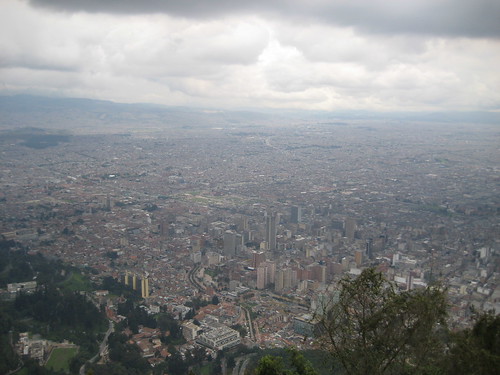
¡Bogotá!

Finally, after delaying my departure date several times and having survived long set of bus trips, I find myself in Bogotá, Colombia's capital city. I am now officially part of FOR Colombia's Bogotá team, and will be working and living here for the next six months. My job will include responding to emergencies in the Peace Community and making sure our team there stays safe, meeting with foreign embassy and Colombian government officials, organizing and leading delegations, and periodically accompanying organizations like the Peasant Farmers Association of Antioquia and the Youth Network of Medellín.

The change has been a shock to my body and soul: to go from living in a tiny village in the middle of mountainous jungle to a chilly city of 6.7 million people is not easy. My eyes smart from the pollution, I shiver all the time from the cold (I know, I'm a wus, but after year of an average 28 degrees centigrade, 15 degrees feels quite cold!), I marvel at my ability to pop down to the corner store, I pine for the vast greenness of the mountains of Urabá. And 9-5 working hours! I am definitely having trouble adjusting to that schedule, and it doesn't help that I arrived just as a scandal errupted about the government illegal spying on members of the poitical opposition, including the Peace Community, in order to sabotage their work, giving us plenty of work to do. I will write more about that scandal very soon, but in the meantime, some photos of my apartment so you have a sense of where I am.

Monday, June 1, 2009

A stranger in our midst

The arrival the other day of a stranger to the caserío of La Unión reminded me of how much this conflict distorts human relations and making people suspicious and fearful of each other.

As usual, those of us in the FOR house (read: the gringos) hadn’t even noticed that a stranger had been hanging around since 10am until two of the community’s internal council members came to the house in the afternoon requesting accompaniment to go speak with the man. (Our obliviousness was likely due to two things: we don’t know each and every family member or long-lost neighbor in this area, so it’s not uncommon for someone who is a stranger to us to pass through, and, despite our training as accompaniers, we aren’t as finely attuned to the subtle daily changes around here.)

Around here, everyone pretty much knows everyone, and this isn’t exactly and easily accessible place (see my post on my commute!), so strangers don’t just tend to wander by. The stranger’s presence here soon raised alarm bells, and a few particularly threatened individuals event went so far as to hide in their beds under the blankets. By the afternoon when he still hadn’t left – in fact, he had been wandering around a bit, raising even more suspicion – the council members asked us to accompany them to talk to him in the kiosko (central community meeting space, covered by a round palm-thatched roof), where he had been hanging out for the previous hour or so. The community members with whom we discussed the incident before heading to the kiosko were quite worried and very visibly shaken up.

Saturday, May 23, 2009

Using my privilege: Clarifications & additional thoughts

I’ve been doing some more reflecting on my last post about exploiting my privilege in my work as a human rights accompanier, and I realized that I oversimplified things quite a bit and perhaps left readers with an incorrect picture of how human rights accompaniment works. In that post I equated the treatment I receive from low-level Colombian functionaries based upon how I look with my effectiveness as a human rights accompanier in preventing harm to the members of the Peace Community. In fact, the power of accompaniment does not lie in the fact that I have blond hair and green eyes, and is only partially due to my U.S. passport (my possession of which one might guess at, but not be sure of, just by looking at me). The majority of our power is based upon all the work we do behind the scenes: meetings with local, regional and national civilian and military officials; the political lobbying and other kinds of political pressure that FOR does in the U.S.; the media coverage we generate. True, my passport gives me greater access to the offices of many Colombian officials (and of course the U.S. embassy) than most Colombians have. But without all of the work we do to open communication channels and demonstrate our ability to exert political pressure, that passport would not allow me, for example, to call up the cell phone of the general who commands the brigade that operates in this region when a combat breaks out nearby or a particular community member is threatened.

That is not to say that accompaniers of color (FOR is unique among accompaniment organizations in Colombia in that it has had several Latinos – and a Sri Lankan-American who looks Latino – serve as accompaniers) don’t have different experiences in certain situations than I do. Several years ago, for example, the road between San José and Apartadó had a paramilitary checkpoint – or at least that’s what FOR heard, because every time accompaniers traveled on the road, the checkpoint was nowhere to be found. Then one day the aforementioned Sri Lankan-American was traveling on the road without his FOR t-shirt on, and the jeep on which he was riding was stopped at the paramilitary checkpoint. Clearly, my blond hair and green eyes do have an effect on the armed actors here, but are neither necessary nor sufficient conditions to be an effective accompanier.

Tuesday, May 19, 2009

Using my privilege, for better or worse

Before I left for Colombia I wrote a question-and-answer post about what I would be doing in Colombia and why. At the time, I wrote:
I fully acknowledge that accompaniment presents a bit of a paradox: my privilege, based on a system of racial and cultural hierarchy that I disavow, helps keep me safe, even while I am taking on a role of solidarity. I do wrestle with this contradiction, and will like write more about it as I carry out my work in Colombia. For the time being, I will say that the role of the accompanier is not to enter people’s lives with an agenda – a way to change, educate, or “help” the community. We come with humility; the community members are the ones who are doing something amazing and we are there simply to support them in their project.

The other day I had an experience that reminded me of my promise to reflect and write about my role as a foreigner here. One of my friends in the community asked me to do a favor for her; she needed someone to pick up a couple of different official forms so she could register her son for his first year of high school (the Peace Community doesn’t have a high school, so kids have to go study in a city, usually Apartadó). She couldn’t go both because the jeep ride to and from town is relatively expensive, and because she had a big corn harvest to attend to. I was going to town anyway, so I agreed to help out.

Tuesday, April 14, 2009

Living simply

“What parts of the simplicity of life here will you take with you when you go back to the States?” my teammate Peter asked me the other day.

Peter is new to the work, the team, the community, and life in the campo (countryside), and therefore is still adjusting to many of the big lifestyle changes one must make in order to (happily) live here. During our time in the Peace Community, us gringos (originally a term referring to folks from the U.S. but around here used to refer to all foreigners) don’t have many of the things that we’re used to from what I tend call our “normal life” back in our home countries: we don’t have the luxury of a refrigerator, microwave, oven, dishwasher, washing machine, nor a clothes dryer. Our house (pictured at left) is made of wood slats with a corrugated tin roof, each room lit by a single naked bulb. Any groceries, household items, office supplies – anything we buy – we have to carry up the mountain.

Despite all the things we don’t have, we arguably have the best house in the village, and count on many comforts our neighbors don’t have: a seat on the toilet (that’s not to say that the flush system functions, however), a computer, two tanks to collect the water piped in from mountain rivers as opposed to just one tank in most houses (see photo at right of our clothes-washing sink and drinking water filter system), a back porch overlooking the garden, a gas cooking range (nearly everyone else cooks with firewood, though a few have electric ranges). Luxury is relative.

Sunday, March 15, 2009

A quick visit to Ecuador

Last week I returned from a much-needed vacation to Ecuador. I say much-needed because given the nature of this work, I am always working: always on call, always a little tense, always anticipating the next crisis. For this vacation I really wanted to leave the country, because even when I'm in some other part of Colombia my phone is still on, Colombian news still reaches my eyes and ears, and I can't really turn off the tension. Luckily, the perfect opportunity fell into my lap: a friend traveling in Ecuador and a cheap plane ticket.

The highlight of the trip was a visit to Otovalo, a pueblo about two hours north of Quito. Otovalo is known for its Saturday crafts market, in which indigenous weavers and artisans come down from the mountains with their wares. The place is PACKED with bags, shawls, scarves, sweaters, necklaces, tableclothes... basically anything woven you could ever want. And yes, I did make a few purchases, in preparation for my upcoming move to chilly Bogota.

Saturday, February 14, 2009

My commute

Since I arrived in the Peace Community, I've wanted to post about my commute - to demonstrate with photos just what it means for me to get home from the nearest town. So, the other day my new teammate Peter and I took photos as we hiked home, lugging backpacks filled with the week's groceries. Take note that by "nearest town" I'm not talking any kind of metropolis - if i want internet access and an actual restaurant, I have to take a 45 minute jeep ride on a dirt road in addition to this hike!

minute 2: just outside of town, crossing a little creek

minute 14: carefully balancing on a log-crossing