Wednesday, April 2, 2014

Peace Is More than Silencing Guns: Human Rights and Colombia’s Peace Process

By: Virginia M. Bouvier, Lisa Haugaard and Moira Birss 


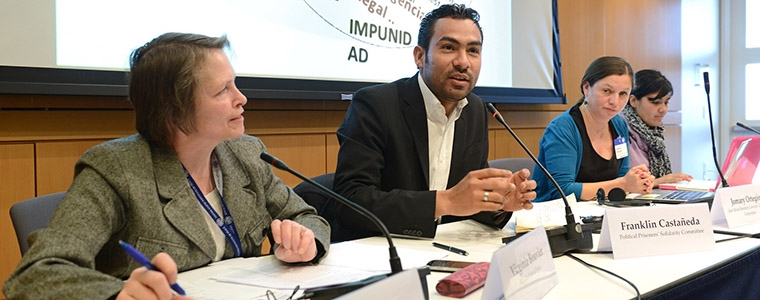
Peace is more than just silencing guns. That was the upshot when Colombian human rights defenders gathered at USIP recently to discuss the ongoing peace process between the FARC guerrillas and Colombia’s government and how the talks can advance justice in the aftermath of a deal. Days later, in a development unrelated to the gathering, the Colombian government took a step in that direction.

Read more here at the USIP website.

Monday, May 6, 2013

"No Justice? No Peace!" The Women Absent from Colombia's Peace Talks

This article originally appeared on The Women's International Perspective on May 3, 2013.


• Yolanda Becerra presenting in the November 2012
Women's Court in the city of Barracabermeja.
Photo credit: Lina Mucha.
•
“No Justice? No Peace!” Never has this chant, which I have heard so often at anti-war rallies, felt so real to me as during the last few months observing the ongoing peace negotiations between the Colombian government and the FARC guerrillas. The talks began in October of last year in Oslo, Norway and have continued in Havana ever since. “No Justice? No Peace!” Never has this belief been more real to women peace activists in Colombia, who, despite the fact that not a single woman is at the negotiating table in Havana, are insisting on justice for achieving real and lasting peace in Colombia. Women peace activists in Colombia are putting their demands for peace into action through grassroots justice initiatives.


Colombia’s nearly five decades of internal armed conflict has wreaked havoc on the country, resulting in countless deaths and leading to the internal displacement of between 4.9 and 5.5 million Colombians – over 10 percent of the country’s population. But even the little-known fact that Colombia’s internally displaced population rivals that of Sudan has received more attention than the ways this conflict has affected women. According to a comprehensive survey carried out in 2010 by national and international organizations, six women an hour were victims of sexual violence between 2001 and 2009.

Tuesday, December 13, 2011

Colombia's mining boom overshadowed by human rights violations

It's been quite a while since I posted here.... Let's just say that PBI has kept me quite busy. One of the things keeping me so busy was a report on the human rights implications of Colombia's mining boom (PDF), published last week. Below is some good media coverage of the report, with several quotes from yours truly, on the English-language news site Colombia Reports. I have an idea or two for original new blog posts, so stay tuned! -Moira

Colombia's mining boom overshadowed by human rights violations: NGO

The apparent success of Colombia's mining boom is being overshadowed by human rights violations and mass displacement from mining areas, international human right organization Peace Brigades International (PBI) said Monday.

"80% of the human rights violations that have occurred in Colombia in the last ten years were committed in mining and energy-producing regions, and 87% of Colombia’s displaced population originate from these places," a report by the organization published last week said.

According to PBI spokesperson Moira Birss, mining activities are frequently accompanied by a disregard of the constitutional rights of minorities and threats and attacks on leaders of these communities.

"Community leaders who oppose mining projects, or the organizations that accompany those leaders and communities, have at times been targeted with threats and even attacks in what would appear to be a result of their opposition, as was the case with the priest who was killed in Marmato," said Birss, referring to an area where mining company Gran Colombia Gold and the local community are at odds over who has the rights to mine for gold.

Wednesday, August 17, 2011

Protecting their mother: Afro-Colombians fight to reclaim their land from palm oil

Upodate: a version of this blog was published on August 30 on the Women's International Perspective.

Palm Oil plantation next to Camelias.
Photo by Charlotte Kesl

The first thing I notice after disembarking from the canoe that carried me across the Curbaradó River and scrambling up the bank are palm oil trees. Their rows of short, stout trunks topped by long green fronds stretch as far as my eye can see. I am visiting the Curbaradó River basin, located in Northwest Colombia near the Panama border, precisely because of the bitter struggle between afro-descendant farming communities and the palm oil companies that had taken over the land after the communities were violently displaced, yet I am taken aback by the overwhelming presence of palm oil trees, destined to become ingredients in cosmetics and snack foods. 

I soon turn my gaze to the military checkpoint a few meters from the river bank. I also know to expect this, and after years traveling in Colombia’s conflict zones, it doesn’t faze me much. My companions and I are waved through their gate made of guadua, a bamboo relative. The soldiers are part of the perimetral protection that Colombia’s Constitutional Court ordered last year as part of a process to restore the land to its “ancestral” inhabitants—those displaced afro-descendant farmers.  

A few more meters down the path I see a white flag suspended on a very long wooden pole. Shortly after, we approach a sign just behind a line of barbed wire fencing announcing the Humanitarian Zone of Camelias. We enter through the gate, passing between two houses suspended a few feet above the ground. I later learn, after hearing some gruesome snakebite tales, that the height protects from snakes, as well as from flooding during the rainy season.

Interviewing Cristobal.
Photo by Charlotte Kesl

After finding the house where we’ll be staying and guarding our groceries from all the tropical bugs in clear plastic tubs, I sit down to talk with Cristóbal Reyes. His baggy dark blue oxford shirt doesn’t hide his slight frame, and he regularly checks his watch to see if it’s time for us to leave to accompany him part of the way back to his home in Nueva Esperanza (New Hope), in the neighboring Jiguamiandó River basin. He doesn’t hesitate, however, when I ask him to tell me about the violence that led to the displacement of all the Afro-descendant and mestizo campesinos – small-scale farmers—in Curbaradó and Jiguamiandó river basins, starting in 1996.

Wednesday, June 29, 2011

Justice... delayed

A couple of weeks ago I was all set to attend my second criminal hearing in Colombia, though this time accompanying the defense lawyer, not a lawyer on the prosecution side (representing the victims is a role permitted in the Colombian justice system), as I did in 2010 in the San Jose de Apartado massacre case. Now, two is more attempts later, I’m seeing first hand some of the frustrations that many of my human rights lawyer friends have expressed about the Colombian judicial system.

I say that I attempted to attend two more hearings because neither of them actually happened.

The first hearing was to take place in early June in the southern department of Putumayo, a region inhabited by several indigenous ethnicities and referred to as the “gateway to the Amazon.” The hearing was to be for a case against two Nasa indigenous men accused of “rebellion,” a charge that alleges collaboration with the guerrillas.

However, for the second time in a row, the hearing was postponed. The lawyer wasn’t notified of the change, though, until we were already en route.

Saturday, May 21, 2011

Hello again, again from Bogota

It’s been a while since my last post, hasn’t it? My excuse for that is the recent rash of big changes in my life: a return to the U.S. after my four month stint back as an accompanier with Fellowship of Reconciliation, a fabulous new job with Peace Brigades International’s Colombia project, and my move across the country from San Francisco to D.C.

As I write this, I've just arrived in Colombia, again. As the new Communications and Outreach Officer (I know, a kinda long title) for PBI Colombia, I’ll be participating in the project’s yearly assembly in Bogota during the next couple weeks, then conducting site visits to several of the field teams. PBI is a human rights accompaniment organization like FOR but on a much larger scale, with field teams in Bogota, the petroleum region of Barrancabermeja, the Uraba region where I spent my first year with FOR, the city of Medellin, and an in-process expansion to the southern city of Cali. 

The move to D.C. has gone smoothly, all things considered. D.C. has never been a place I’d had a hankering to live in; in fact, until really recently I more or less refused to look at D.C.-based job postings and bemoaned what I thought of as the "Beltway bubble". But then this job came along, allowing me to continue doing the work I love of supporting communities and organizations in Colombia doing incredible and inspiring human rights work, and I couldn’t pass it up. Besides, PBI is unique among most organizations with D.C. offices in that our staff is overwhelmingly based in-country, which helps keep me out of, or at least on the very edge of, the Beltway bubble.

Given my new job, I’ll be continuing to write about human rights in Colombia, but from a style a bit different than you’re likely used to from my previous posts and articles: it will be more about the communities and organizations PBI accompanies and the problems they face and less direct political analysis. As always, I’d love your feedback, and suggest you also check out PBI Colombia’s blog, where I will be editing and, at times, writing, as well as our Facebook page.

Thanks for your support!

Tuesday, April 19, 2011

Protect Threatened Afro-Colombian and Mestizo Communities in Curvaradó and Jiguamiandó

This urgent action is from the Latin American Working Group on behalf of a community I work with. Please take action!

Community leader Don Petro
photo by Charlotte Kesl
Many of the communities living in the Curvaradó and Jiguamiandó river basins in Colombia’s northwest Urabá region have come under great threat this past week.

Will you send a message to the Colombian government today to ask for their protection?

After being violently displaced in the late 1990s, the Afro-Colombian and mestizo communities in Curvaradó and Jiguamiandó created "Humanitarian Zones," or areas where the peaceful civilians who declared themselves neutral in the conflict could be clearly differentiated from combatants and protect themselves and their families from the violence. Since then they have been working for a peaceful return to their lands, but continue to face often violent challenges from paramilitaries, cattle ranchers and oil palm companies that want control of these territories. Click here to watch a short video about their history and struggle.

National and international courts have ordered the Colombian government to give back the land to these communities and protect them from violence. While almost none of the land has been returned to the communities, the Colombian Army had been providing some important protection around the outside of the humanitarian zones.

But last week the Army retreated from several of their established and agreed upon protection posts. Around the time that the Army pulled back, a group of 20 paramilitaries armed with assault weapons was reported to be near the humanitarian zone of Andalucia-Caño Claro. Within days, paramilitaries armed with machetes tried to stab a community member, who narrowly escaped by running off into a field. And now the communities fear that an attack is imminent. 

Click here to ask Colombian government to protect them now!

Tuesday, April 5, 2011

Resisting Violence through Sustainable Agriculture in Colombia

This article originally appeared on The Women's International Perspective.


• A hand-made sign lists 12 varities of bananas grown in the Peace Community of San José de Apartadó. Photograph courtesy of the author. •
In the middle of one of the most fertile regions in Colombia, amidst a five-decade armed conflict, a small peasant community manages to serve as a model of civilian resistance against violence and displacement. But as I saw when I returned in February to the Peace Community of San José de Apartadó, located in the northwestern province of Antioquia, their sustainable agriculture projects not only defend against violence but also create life.

“These are proyectos de vida, explains Javier, the Community member who manages the Community’s new agriculture center. These projects of life, as the name indicates, are more than an effort to reduce the Peace Community’s ecological footprint, to eat locally, and to reduce reliance on outside food sources. They are called proyectos de vida because they also serve as a survival mechanism against violence and a strategy against displacement.

With nearly two hundred Peace Community members killed since 1997 and thousands of human rights violations committed by guerrilla, paramilitary, and state armed forces, the Peace Community’s survival depends on a constant struggle to defend life. “We have to create our own principles and laws about land, and collectively defend the land,” Javier explains to me on my recent visit. “It is because of resistance, collectivity, and community that we have managed to stay.”

The Peace Community developed the agriculture center in the last year to serve as a hands-on agricultural research and learning facility for the development of food self-sustainability. The center includes a plant nursery, medicinal plant garden, worm bin for composting, and several acres dedicated to experimenting with the various varieties of crops grown in the region such as a banana field with 12 varieties of the fruit. Springs are being protected in order to conserve water sources, some of which feed into fish breeding ponds.

“Many peasants believe that what comes from outside is better than what we have. But no,” explains Javier. “That is why we have been working so hard in the agriculture center…to care for [what we have] and [to learn] how to care for our own resources, including farm animals.”

Sunday, April 3, 2011

Soccer fever: what's violence got to do with it?

The stereotype of Latin Americans as soccer fanatics is, in my experience, pretty spot on, and members of the Peace Community are no exception. The men, and some of the women, religiously watch national league games, as well as, of course, games in which the national team plays. Many afternoons, kids and some of the younger men gather for pickup games, and periodically a tournament gets organized between teams of the different neighboring villages.

But, claims Raúl (name changed), a community member and avid soccer player and watcher, the soccer fever of today is nothing like in the 1980s.

I am sitting with Raúl, a visitor from a neighboring village named Daniel, and my teammate Jon under the tin roof of our neighbor’s house. It rained all night and is still raining, so most folks haven’t gone to work in the fields and are hanging out under a few porch roofs, passing the time telling stories and jokes until the rain lets up and they can go chop weeds in their cacao orchards or finish up the thatch roof on a new community building.

“In the 1980s,” he says, “La Union had an excellent team, fully loaded with great players from goal keeper to forward. That’s because everyone was very disciplined,” Raúl says Every afternoon, even after working a full day in the fields, guys would meet at the soccer field on the outskirts of the village to practice, rain or shine. And training would start very young so that by the time they were teenagers, boys would be good enough to play on the men’s team.

Friday, March 18, 2011

Not just peace-building, but life-building

Returning this February to the Peace Community after over a year since my last visit, I was reminded that one of the most amazing things about the Community is that it has not only served as a model of civilian resistance in the midst of an armed conflict for 14 years, but that in such a context it manages to designs and implement alternative development models, or what it calls proyectos de vida—life projects. 

A sign lists the 12 types of bananas grown here
The newest proyecto de vida that I discovered upon my return was a centro agricola, or agriculture center, founded in the time I was away. The Community designed the center to serve as a hands-on agricultural research and learning center for the development of conservation food self-sustainability. The center includes a plant nursery, medicinal plant garden, worm bin for composting, and several acres dedicated to experimenting with the various varieties of crops grown in the region—like a banana field with 12 varieties of the fruit. Springs are being protected in order to conserve water sources, some of which feed into fish breeding ponds.

“These are proyectos de vida, explains Javier, the Community member who manages the center. “Many peasants believe that what comes from outside is better than what we have. But no. That is why we have been working so hard in the agriculture center here in the community, learning to care for [what we have], how to have a seed bank, how to care for our own resources, including farm animals. Sometimes people come with so many things from outside that at the end of the day turn out harming us.”

Thursday, February 10, 2011

Nice to meet you, I’m a Kyrgyz nuclear physicist

No matter where I go in Colombia, conversations almost always start with the other person asking me where I’m from. Even before I open my mouth to reply and my gringo-tinted accent reveals my foreign origins, my blond hair gives me away.

I tend to be most inundated with this question when I go dancing with Colombian friends in spots rarely frequented by foreigners. When I get asked to dance by an unknown Colombian, the first phrase out of his mouth is always a question about where I'm from. That is quickly followed by a comment on how well I can dance (though without saying what he's surely thinking: that I dance well…for a gringa), then by questions about how long I've been here, what I'm doing here, and if I like Colombia.

After dancing a few songs in which the dialogue is always the same, I often find myself getting bored, if not with the dancing then certainly with the conversation. To spice things up, I’ll sometimes invent a new identity for myself, saying that I'm from Sweden, or that I'm a psychologist.

Monday, January 31, 2011

The hired help

Not long before I left Bogotá the last time, in March 2010, FOR (the organization I work with) found itself having to find a new apartment for its volunteers in Bogotá. One of the first things we put on the list of requirements for the new place was a permanent doorman. Though we had had a part time doorman (actually, a doorwoman) in the previous apartment, the apartment was robbed in 2006. It's still unclear exactly what happened, but it probably didn't help that the doorwoman was part time and all the neighbors had keys to the front door.

Having a doorman is not uncommon in Colombia. Many, if not most, middle class apartment buildings, and all upper class ones, do. Most also have empleadas: part-time, or in the case of many upper-class households, full-time, maids. So do all offices, including the office FOR shares with a Colombian NGO. Éxito, the chain store that I consider a slight nicer version of Walmart (though I’ve never actually been in Walmart so it’s just a guess), sells, next to the towels and sheets, uniforms for you to purchase for your empleada.

Despite doormen and empleadas being ubiquitous, I still don’t feel entirely comfortable having a doorman (note: I sweep my own floors). My little building employs two men who alternate shifts every 24 hours. No one besides them has keys to the front gate and door, so even when I come home at 4am after a night of dancing, they have to open the front door to let me in; I'm sure I have awoken them several times. I feel badly every time, but I have no other way to get in.

Wednesday, January 19, 2011

The oft-ignored incidence of sexual violence in Colombia’s conflict

Six every hour, 149 per day, 54,410 per year.
 
That’s how many women on average, according to a recent study, were direct victims of sexual violence in Colombia from 2001-2009 in areas with presence of armed actors (military, paramilitary or police).
 
Violence against women has remained a seldom-discussed consequence of Colombia’s conflict. This study, however, seems to be generating a bit more attention to the issue. So too, hopefully, is the recent denunciation by ONIC, the National Indigenous Orgainzation in Colombia, of the trafficking of indigenous girls.

Indigenous adolescent girls, ONIC Secretary Luis Evelis Andrade revealed, are being kidnapped from their villages, raped and/or forced into prostitution. Some girls are returned to their homes after a few days. Others never return.

Wednesday, January 5, 2011

What makes a city? Or, The sounds of Bogotá

It turns out that a friend I had been hoping to see upon my return to Colombia moved to Houston a few months ago, so I won't get to see him. When I asked, via email, how he was liking life in the USofA, he admitted that he's finding Houston hard to adapt to. Among the most difficult things, he said, is the fact that he feels like people look at him like he's crazy if he attempts to walk somewhere, instead of racing from air-conditioned house to air-conditioned office to air-conditioned car to air-conditioned house, ad infinitum. 

As a Colombian, he wrote, “The concept of city that I have is very different than this. I believe that a city is a network of genetic, cultural, phenotypic, and environmental information of a specific area that is totally dynamic and symbiotic, and inhabited by our species.”

His email arrived just after I had finished writing in my journal about the noises of Bogotá. That morning, I had been awakened by some combination of the hot morning sun rendering my curtains useless, taxis roaring down the street outside my single-pane window, the local bar blaring merengue as workers cleaned up from the previous night's almost-New-Year's-Eve revelry, and the head cold that had come to settle in my nose. I turned over and tried to fall back asleep, but to no avail.

Despite my desire for a few more winks, the chaos that awoke me exemplified one of the things that I have come to identify with Latin American cities--or at least Bogotá, since it's the one I know the best: the cacauphony of sounds continously bouncing off the dirty concrete walls and cracked sidewalks.

On any morning spent sitting in my apartment or walking to the corner store (of which there really is one on every corner, if not more than one), I am likely to here many, if not all, of the following sounds:

Thursday, December 30, 2010

I'm Back in Colombia

After four days of travel (included being sent back to San Francisco for two days!), I made it to Colombia on the 22nd, greeted by mariachis-for-hire at the Bogota airport. (Ok, so the mariachis weren't for me, but it was an amusing welcome admist the chaos that is the Bogota airport at 10pm on a major holiday travel day.)

I have returned to work with FOR, the organization I worked with the last time I was in Colombia. I will be here for at least a few months to help out with a gap in staff and to train new staff. I'm excited for the opportunity to dive back into this meaningful work, to see friends, to conduct interviews for some articles I'd like to write, and to gain a new perspective on the place and the work after 10 or so months of being in the U.S. And to write more blog posts!

This marks my third holiday season in a row spent in Colombia. My first I spent in the Peace Community, eating bunuelos and dancing vallenato with campesinos in rubber boots. Last year, a visiting college friend and I traveled to where the desert meets this Caribbean ocean, La Guajira, and were treated to the traditional Christmas meal of goat cooked in goat fat (I tried it...).

Friday, December 10, 2010

The Hidden Side of Violence in Ciudad Juárez: Student Shot by Federal Police

This article was published today on The Women's International Perspective, where I have previously published several articles about Colombia. It's similar to the previous post, but geared at a wider audience. Enjoy!


• A mural worked on by Juárez artists during the Foro. The left side is a depiction of civil society. The right depicts death and destruction by the federal forces and other violent actors. Photograph courtesy of the author. •
“Ciudad Juárez won’t be a big deal. You spent two years in Colombia!” my friend reassures me.
“Yeah,” I reply with nervous knots in my stomach, “but isn’t Juárez one of the most dangerous cities in the world?”

The violence wracking Mexico, largely fueled by the country’s drug war, is magnified in the border town of Ciudad Juárez, just across the Rio Grande from El Paso, Texas. So even though I spent two years as a human rights accompanier in Colombia visiting some of the country’s most dangerous regions, the concentration and apparent randomness of the violence in Juárez left me apprehensive about my upcoming trip.

Just days before my departure the last weekend in October, four maquila factory workers were killed and fifteen more injured when gunmen shot up three company buses carrying the workers home. The following weekend, 20 more were killed. Since 2008, the murder rate has surpassed 6,500 in a city of about 1.5 million.

Tuesday, November 23, 2010

My trip to Ciudad Juarez: A glimpse into the hidden side of Mexico’s violence

I wrote this piece for the latest Colombia Update from the Fellowship of Reconciliation, the organization I worked with in Colombia.

mural in Juarez1
A mural painted by Foro participants
When FOR staff asked if I could travel to a conference on civilian resistance to militarism in Ciudad Juarez, Mexico during the last weekend in October, I jumped at the chance to visit a country often compared to Colombia, where I recently spent two years as a human rights accompanier.

However, as my departure date grew closer, I became more and more nervous. The violence wracking Mexico, largely fueled by the country’s drug war, is magnified in the border town of Juarez, just across the Rio Grande from El Paso, Texas, and often vies for the dubious title of most dangerous city in the world. So just because I spent two years in Colombia as a human rights accompanier, and knew that the mainstream news stories about Mexico I had read didn’t tell the whole story, the concentration and apparent randomness of the violence in Juarez, at least as portrayed in mainstream media, worried me.

Just days before my departure for Ciudad Juarez, for example, four maquila factory workers were killed and fifteen more injured when gunmen shot up three company buses carrying the workers home. Since 2008, the number of murders has surpassed 6,500 in a city of about 1.5 million. New York City, with a population of 8.3 million, had just 1,570 murders in a similar period.

Friday, November 19, 2010

Latin American Peoples Organize to Resist Increased Militarization in the Region

My article, originally published on War Times

Monday, October 25, 2010

Help release conscientious objector detained at army base

This post is a call to action from the Fellowship of Reconciliation, by my former colleagues Rachel and Peter. Please take action!
 
Juan Diego is a young campesino in the municipality of Andes, a few hours southwest of Medellin. He works on a farm to help support his parents and two little sisters; his father’s income as a day-laborer is not enough to feed the whole family. On September 5, Juan Diego was grocery-shopping for his family in town when soldiers came up to him and asked for his papers. When he told them he did not have his military service booklet, he was pushed into a truck and taken to the 11th battalion of the 4th Brigade. They took away his identification and have still not returned it to him. 

CALL TO ACTION

You can take action to help have Juan Diego released!!

1. Call the 4th Brigade in Medellín (011 574 493 9290 ext. 111) and ask for his immediate release.

2. Call the Ombudsman of Antioquia (011 574 218 1577 ext. 101) and ask for Doctora Sandra Maria Rojas to intervene in the release of Juan Diego.

Tell them this: “Llamo para expresar mi preocupación por la detención arbitraria e ilegal de Juan Diego Agudelo Correa, numero de cédula 1027885649, en el municipio de Andes (Antioquia) el día 5 de septiembre. Juan Diego se encuentra prestando servicio militar en el Batallón 11 de la Cuarta Brigada, pero se ha declarado objetor por conciencia, postura que tiene el amparo de la Corte Constitucional en el fallo C-728 de 2009. Quiero pedir que usted colabore para que el derecho fundamental de Juan Diego a declararse objetor, a través de una tutela, sea confirmado. Muchas gracias.”

I am calling to express my concern at the arbitrary and illegal detention of Juan Diego Agudelo Correa, ID number 1027884569, in the municipality of Andes (Antioquia) on the 5th September. Juan Diego is currently performing obligatory military service in the 11th Battalion of the 4th Brigade, but has declared himself a conscientious objector, a position that the Constitutional Court has backed in sentence C-728 (2009). I ask for your assistance so that Juan Diego’s fundamental right to declare himself a conscientious objector, by way of a writ, is upheld. Many thanks.
In Juan Diego’s words, “Since that day I have been in the base against my will, because I do not want to perform obligatory military service. In the first place, because my moral principles don’t let me participate in the war and so I do not want to be part of any army or armed force. And second, because my highest priorities are my family, which needs me to continue to work, and to continue my high school studies, which I had to temporarily suspend because of the economic difficulties in my family.” (link to declaration) The day after he signed this declaration of conscientious objection, the soldiers in the battalion asked who did not want to be there. Juan Diego replied that he did not want to be in the army because he does not agree with the war. The soldiers laughed, made fun of him, and answered that there wasn’t a chance in hell they would let him go. 

Juan Diego is a conscientious objector. He was arbitrarily detained and is being forced to serve in the Colombian military. There are differing views on the legality of Juan Diego’s recruitment, depending on whom you ask. According to Lieutenant Colonel Juan Carlos Quiroz, who directs operations in the 4th Recruitment Zone, which has jurisdiction over Andes, the Colombian Constitution says that the military can go out and compel men to serve in the army (according to Col. Quiroz this includes using force). “No one wants to serve, so what am I supposed to do?” Colonel Quiroz asked us. Lieutenant An officer of the “Cacique Nutibara” Battalion 11 in Andes told us that he feels he is doing youth a favor when he rounds them up in trucks: “Many of the kids don’t have the money to pay for transportation to the brigade’s base to enlist, so we provide the transportation for them.” 

Thursday, September 9, 2010

Soldiers off the hook for 2005 Peace Community massacre

Despite lots of credible evidence and international attention, Colombian government and military are officially off the hook for the February 2005 massacre in the Peace Community of San Jose de Apartado in which four adults and four children were brutally murdered. On August 18, a judge in Medellin exonerated ten members of the Colombian military who had been on trial for participation in the massacre in a more-than-100 page sentence that had me alternating between tears and sighs of frustration as I read it.

As I wrote in an article on Alternet earlier this year, the 2005 massacre case is emblematic not just as an example of the brutality suffered by civilians at the hands of the Colombian military and paramilitaries, but also of the Colombian state's efforts to maintain impunity in such cases. While the Peace Community has always insisted that the army and paramilitaries committed the crime, initially the Colombian government tried to lay blame on the victimized community itself. In fact, shortly after the massacre Colombian President Álvaro Uribe himself publicly accused the community of guerrilla collaboration, backing up army officials who claimed the FARC had committed the massacre to punish the community for collaboration gone awry. It has since been proven that army officials paid false witnesses to testify that the FARC committed the massacre.

Despite such revelations of witness buying, this ruling allows the government to again claim innocence and place blame solely on the paramilitaries. Sadly, the ruling, though extremely frustrating, is not terribly surprising, in spite of the strong evidence against the soldiers. Colombia is, after all, a country with a sky-high impunity rate (the ruling against retired Colonel Plazas Vega I wrote about recently was the first of its kind), the trial took place in a city notorious for military/paramilitary control over government institutions, and the ruling was handed down by a judge who likely received all kinds of pressure to let the soldiers off the hook.

For better or worse, a careful reading of the ruling reveals some faulty logic on the part of the judge that leaves plenty of room open for an appeal. The legal team representing the families of the victims of the massacre did an analysis of the ruling (including the very-at-risk human rights lawyer Jorge Molano, who I wrote about last year), and I’ve taken some points from that as well as added a bit of my own analysis: